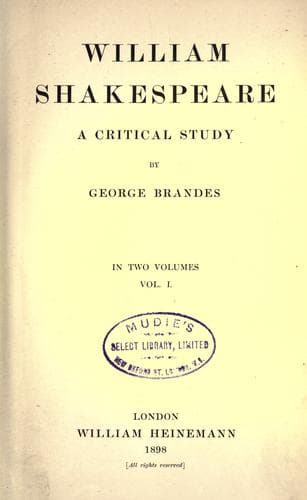
William Shakespeare: A Critical StudyBrandes, Georg
General
William Shakespeare: A Critical Study
Brandes, Georg
Shakespeare, William, 1564-1616 -- Criticism and interpretation
"All furnished, all in arms,
All plum'd like estridges that wing the wind;
Bated like eagles having lately bath'd;
Glittering in golden coats, like images;
As full of spirit as the month of May,
And gorgeous as the sun at midsummer;
Wanton as youthful goats, wild as young bulls.
I saw young Harry, with his beaver on,
His cuisses on his thighs, gallantly arm'd,
Rise from the ground like feather'd Mercury,
And vaulted with such ease into his seat,
As if an angel dropp'd down from the clouds,
To turn and wind a fiery Pegasus,
And witch the world with noble horsemanship."
[1]
"And Achilles at last _Brake suddenly forth into weeping_,
and turned from his comrades aside, And sat by the cold grey
sea, looking forth o'er the harvestless tide." _Iliad_, i.
348.
"So when to the tents and the ships of the Myrmidon host they had won,
They found him delighting his soul as rang to the sweep of his hand
His beautiful rich-wrought lyre with a silver cross-bar spanned,
Which he chose from the spoils of the war when he smote Eëtion's town.
Sweetly it rang as he sang old deeds of hero-renown."
_Iliad_, ix. 185.
So Greek and so musical is he who can yet give this answer to the dying
Hector's appeal:--
"'Knee me no knees, thou dog, neither prate of my parents to
me! Would God my spirit within me would leave my fury free
To carve the flesh of thee raw, and devour, for the deeds
thou hast done.'" _Iliad_, xxii. 345.
(Translated by Arthur S. Way.)
XXIV
_PRINCE HENRY--THE POINT OF DEPARTURE FOR SHAKESPEARE'S IMAGINATION--A
TYPICAL ENGLISH NATIONAL HERO--THE FRESHNESS AND PERFECTION OF THE PLAY_
Henry V. was, in the popular conception, the national hero of England.
He was the man whose glorious victories had brought France under
English rule. His name had a ring like that of Valdemar in Denmark,
bringing with it memories of a time of widespread dominion, which
the weakness of his successors had suffered to shrink again. As a
matter of history, Henry had been a soldier almost from his boyhood,
had been stationed on the Welsh borders from his sixteenth to his
one-and-twentieth year, and had afterwards, in London, enjoyed the full
confidence of his father and of the Parliament. But there was some
hint in the old chronicles of his having, in his youth, frequented
bad company and led a wild life which gave no foretaste of his coming
greatness. This hint had been elaborated in the old and worthless play,
_The Famous Victories_; and no more was needed to set Shakespeare's
imagination to work, and render it productive. He revelled in the idea
of representing the young Prince of Wales roistering among drunkards
and demireps, only to rise all the more brilliantly and superbly into
the irreproachable sovereign, the greatest soldier among England's
kings, the humiliator of France, the victor of Agincourt.
Public-domain text, read in full here on John Shaqi.
Reviews
Reviews
No reviews yet
Be the first to share your thoughts on this work.
Elsewhere in the archive
Join the Discussion
Join the discussion
Sign in to leave a comment or review.
Sign InorCreate an account