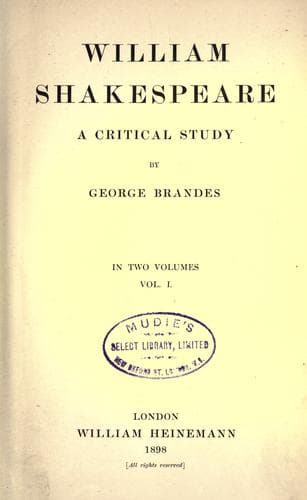
William Shakespeare: A Critical StudyBrandes, Georg
General
William Shakespeare: A Critical Study
Brandes, Georg
Shakespeare, William, 1564-1616 -- Criticism and interpretation
We see him, indeed, plunging into the most boyish and thoughtless
diversions, in company with topers, tavern-wenches, and pot-boys; but
we see, also, that he is magnanimous, and full of profound admiration
for Harry Percy, that admiration for a rival of which Percy himself was
incapable. And he rises, ere long, above this world of triviality and
make-believe to the true height of his nature. His alert self-esteem,
his immovable self-confidence, can early be traced in minor touches.
When Falstaff asks him if "his blood does not thrill" to think of the
alliance between three such formidable foes as Percy, Douglas, and
Glendower, he dismisses with a smile all idea of fear. A little later,
he plays upon his truncheon of command as upon a fife. He has the great
carelessness of the great natures; he does not even lose it when he
feels himself unjustly suspected. At bottom he is a good brother, a
good son, a great patriot; and he has the makings of a great ruler.
He lacks Hotspur's optimism (which sees some advantage even in his
father's desertion), nor has he his impetuous pugnacity; yet we see
outlined in him the daring, typically English conqueror, adventurer,
and politician, unscrupulous, and, on occasion, cruel, undismayed
though the enemy outnumber him tenfold--the prototype of the men who, a
century and a half after Shakespeare's death, achieved the conquest of
India.
It is a pity that Shakespeare could find no other way of displaying
his military superiority to Percy than simply to make him a better
swordsman and let him kill his rival in single combat. This is a return
to the Homeric conception of martial prowess. It was by such traits as
this that Shakespeare repelled Napoleon. These things appeared to him
childish. He found more "politics" in Corneille.
With complete magnanimity, Prince Henry leaves to Falstaff the
honour of having slain Hotspur, that honour whose true nature forms
the central theme of the whole play, although the idea is nowhere
formulated in any individual speech. But after Henry Percy's death,
Shakespeare, strangely enough, sometimes actually transfers to Henry
Plantagenet his fallen rival's characteristics. He says, for example
(_Henry V_., iv. 3), "If it be a sin to covet honour, I am the most
offending soul alive." He declares that he understands neither rhyme
nor metre. He woos his bride as ungallantly as Hotspur talks to his
Kate, and he answers the challenges of the French with a boastfulness
that throws Hotspur's into the shade. In _Henry V_. Shakespeare strikes
the key of pure panegyric. The play is a National Anthem in five acts.
Public-domain text, read in full here on John Shaqi.
Reviews
Reviews
No reviews yet
Be the first to share your thoughts on this work.
Elsewhere in the archive
Join the Discussion
Join the discussion
Sign in to leave a comment or review.
Sign InorCreate an account