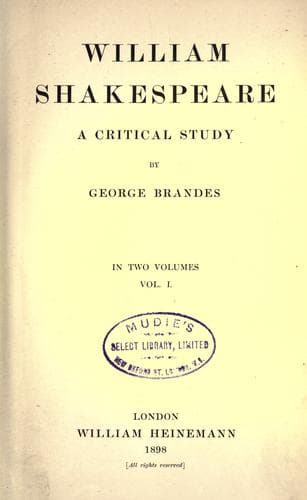
William Shakespeare: A Critical StudyBrandes, Georg
General
William Shakespeare: A Critical Study
Brandes, Georg
Shakespeare, William, 1564-1616 -- Criticism and interpretation
We must remember that Shakespeare from the first could not treat this
character with perfect freedom. There is a touch of reverence, of
patriotic religion in his tone, even where he shows the Prince given
over to wild and wanton frolics. At the close of the Second Part of
_Henry IV_. he is already transformed by his sense of responsibility;
and he develops, as Henry V., a sincerely religious frame of mind,
based on personal humility and on the consciousness of his father's
defective right to the throne, which no one could ever have divined in
the light-hearted Prince Hal.
These later plays, however, are not to be compared with this First Part
of _Henry IV_., which in its day made so great and well-deserved a
success. It presented life itself in all its fulness and variety, great
typical creations and figures of racy reality, which, without standing
in symmetrical antithesis or parallelism to each other, moved freely
over the boards where a never-to-be-forgotten history was enacted. Here
no fundamental idea held tyrannical, sway, forcing every word that was
spoken into formal relation to the whole; here nothing was abstract.
No sooner has the rebellion been hatched in the royal palace than the
second act opens with a scene in an inn-yard on the Dover road. It is
just daybreak; some carriers cross the yard with their lanterns, going
to the stable to saddle their horses; they hail each other, gossip, and
tell each other how they have passed the night. Not a word do they say
about Prince Henry or Falstaff; they talk of the price of oats, and of
how "this house is turned upside down since Robin ostler died." Their
speeches have nothing to do with the action; they merely sketch its
locality and put the audience in tune for it; but seldom in poetry has
so much been effected in so few words. The night sky, with Charles's
Wain "over the new chimney," the flickering gleam of the lanterns in
the dirty yard, the fresh air of the early dawn, the misty atmosphere,
the mingled odour of damp peas and beans, of bacon and ginger, all
comes straight home to our senses. The situation takes hold of us with
all the irresistible force of reality.
Shakespeare must have written this drama with a feeling of almost
infallible inspiration and triumphant ease. We understand in reading
it what his contemporaries say of his manuscripts: he did not blot a
single line.
The political developments arising from Henry IV.'s wrongful seizure of
the throne of Richard II. afford the groundwork of the play.
Public-domain text, read in full here on John Shaqi.
Reviews
Reviews
No reviews yet
Be the first to share your thoughts on this work.
Elsewhere in the archive
Join the Discussion
Join the discussion
Sign in to leave a comment or review.
Sign InorCreate an account