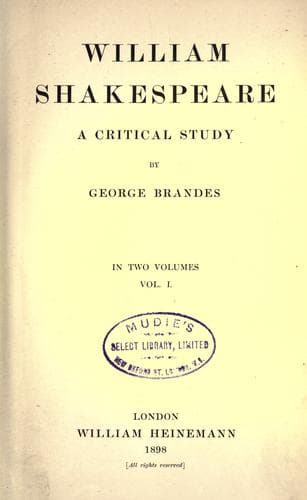
William Shakespeare: A Critical StudyBrandes, Georg
General
William Shakespeare: A Critical Study
Brandes, Georg
Shakespeare, William, 1564-1616 -- Criticism and interpretation
The King, situated partly like Louis Philippe, partly like Napoleon
III., does all he can to obliterate the memory of his usurpation. But
he does not succeed. Why not? Shakespeare gives a twofold answer. First
there is the natural, human reason: the relation of characters and
circumstances. The King has risen by the "fell working" of his friends;
he is afraid of falling again before their power. His position forces
him to be mistrustful, and his mistrust repels every one from him,
first Mortimer, then Percy, then, as nearly as possible, his own son.
Secondly, we have the prescribed religious reason: that wrong avenges
itself, that punishment follows upon the heels of guilt--in a word,
the so-called principle of "poetic justice." If only to propitiate
the censorship and the police, Shakespeare could not but do homage to
this principle. It was bad enough that the theatres should be suffered
to exist at all; if they so far forgot themselves as to show vice
unpunished and virtue unrewarded, the playwright would have to be
sternly brought to his senses.
The character of the King is a masterpiece. He is the shrewd,
mistrustful, circumspect ruler, who has made his way to the throne by
dint of smiles and pressures of the hand, has employed every artifice
for making an impression, has first ingratiated himself with the
populace by his affability and has then been sparing of his personal
presence. Hence those words of his which so deeply impressed Sören
Kierkegaard,[2] who despised and acted in direct opposition to the
principle they formulated (Pt. i. iii. 2):--
"Had I so lavish of my presence been,
So common-hackney'd in the eyes of men,
So stale and cheap to vulgar company,
Opinion, that did help me to the crown,
Had still kept loyal to possession,
And left me in reputeless banishment,
A fellow of no mark, nor likelihood.
By being seldom seen, I could not stir,
But like a comet I was wonder'd at."
He thus illustrates, from the point of view of an old diplomatist, the
injury his son does himself by flaunting it among his disreputable
associates.
Yet the son is not so unlike the father as the father believes.
Shakespeare has made him, in his own way, adopt a scarcely less
diplomatic policy: that of establishing a false opinion about himself,
letting himself pass for a frivolous debauchee, in order to make
all the deeper impression by his firmness and energy as soon as an
opportunity offers of showing what is in him. Even in his first
soliloquy (i. 2) he lays down this line of policy with a definiteness
which is psychologically feeble:--
"I know you all, and will awhile uphold
The unyok'd humour of your idleness.
Yet herein will I imitate the sun,
Who doth permit the base contagious clouds
To smother up his beauty from the world,
That when he please again to be himself,
Being wanted, he may be more wondered at."
Public-domain text, read in full here on John Shaqi.
Reviews
Reviews
No reviews yet
Be the first to share your thoughts on this work.
Elsewhere in the archive
Join the Discussion
Join the discussion
Sign in to leave a comment or review.
Sign InorCreate an account