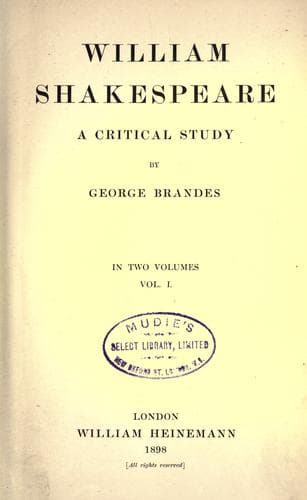
William Shakespeare: A Critical StudyBrandes, Georg
General
William Shakespeare: A Critical Study
Brandes, Georg
Shakespeare, William, 1564-1616 -- Criticism and interpretation
This self-consciousness on Henry's part was to some extent imposed
upon Shakespeare. Without it, he could scarcely have brought upon the
stage, in such questionable company, a prince who had become a national
hero. Yet if the Prince had acted with the cut-and-dried deliberation
of purpose which he here attributes to himself, we should have to write
him down an unmitigated charlatan.
Here, as in a former instance of psychological crudity--Richard III.'s
description of himself as a villain--we must allow for Shakespeare's
use of the soliloquy. He frequently regards it as an indispensable
stage-convention, which does not really reveal the inmost thoughts of
the speaker, but only serves to place the hearer at a certain point
of view, and to give him information which he needs. Furthermore,
such a soliloquy as this ought to be spoken with a good deal of
sophistical self-justification on the Prince's part, or else, as the
German actor, Josef Kainz, treats it, in a tone of gay raillery.
Finally, it is to be regarded as a first hint--rather a broad one,
it must be admitted--which Shakespeare gives us thus early in order
to get rid of the improbability he found in the Chronicle, where the
Prince is instantaneously and miraculously transformed through a
single resolve. The soliloquy is introduced at this point to ensure
the coherence of his character, lest the spectator should feel that
the Prince's conversion to a totally different manner of life was
mechanically tacked on and had no root in his inner nature. And it must
have been one of the chief attractions of the theme for Shakespeare
to show precisely this conversion. No doubt he enjoyed depicting his
hero's gay and thoughtless life, at war with all the morality which
is founded on mere social convention; but at least as great must have
been the pleasure he took, as a man of ripe experience, in vindicating
that morality which he now felt to be the determining factor in human
life--the morality of voluntary self-reform and self-control, without
which there can be no concentration of purpose or systematic activity.
When the new-crowned king will no longer recognise Falstaff, when he
repulses him with the words:--
"How ill white hairs become a fool and jester....
Reply not to me with a fool-born jest;
Presume not that I am the thing I was,"
he speaks out of Shakespeare's own soul. Behind the words there glows
a new-born warmth of feeling. The calm sense of justice of the island
king makes haste to express itself, and to refuse all further dallying
with evil. He grants Falstaff a maintenance and banishes him from his
presence. Shakespeare's hero is at this point a living embodiment of
that earnestness and sense of responsibility which the poet, whom one
of his greatest and ablest admirers (Taine) has represented as being
devoid of moral feeling, held to be the indispensable condition of all
high endeavour.
Public-domain text, read in full here on John Shaqi.
Reviews
Reviews
No reviews yet
Be the first to share your thoughts on this work.
Elsewhere in the archive
Join the Discussion
Join the discussion
Sign in to leave a comment or review.
Sign InorCreate an account