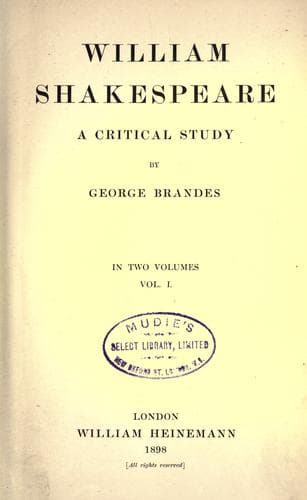
William Shakespeare: A Critical StudyBrandes, Georg
General
William Shakespeare: A Critical Study
Brandes, Georg
Shakespeare, William, 1564-1616 -- Criticism and interpretation
[1] This tradition seems in no way improbable, and its
probability is not diminished by the fact that an anecdote connected
with it has been shown by Halliwell-Phillips to be an old Joe Miller,
merely adapted to the case in point. "One day an old townsman,
observing the boy running homeward almost out of breath, asked him
whither he was posting in that heat and hurry. He answered to see his
_god_father Shakespeare. 'There is a good boy,' said the other; 'but
have a care that you don't take _God's_ name in vain'" (_Oldys_).
[2] A Danish ethical and theological thinker, a Northern
Pascal, said to have in some measure suggested to Ibsen the character
of Brand.
XXV
"_KING HENRY IV.," SECOND PART--OLD AND NEW CHARACTERS IN
IT--DETAILS--"HENRY V.," A NATIONAL DRAMA--PATRIOTISM AND
CHAUVINISM--THE VISION OF A GREATER ENGLAND_
The Second Part of _Henry IV_., which must have been written in 1598,
since Justice Silence is mentioned in Ben Jonson's _Every Man out of
his Humour_, acted in 1599, abounds, no less than the First Part, in
poetic power, but is only a dramatised chronicle, not a drama. In its
serious scenes, the play is more faithful to history than the First
Part, and it is not Shakespeare's fault that the historical characters
are here of less interest. In the comic scenes, which are very amply
developed, Shakespeare has achieved the feat of bringing Falstaff
a second time upon the stage without giving us the least sense of
anticlimax. He is incomparable as ever in his scenes with the Lord
Chief-Justice and with the women of the tavern; and when he goes down
into Gloucestershire in his character of recruiting-officer, he is
still at the height of his genius. As new comrades and foils to him,
Shakespeare has here created the two contemptible country Justices,
Shallow and Silence. Shallow is a masterpiece, a compact of mere
stupidity, foolishness, boastfulness, rascality, and senility; yet he
appears a genius in comparison with the ineffable Silence. Here, as
in the First Part, the poet evidently drew his comic types from the
life of his own day. Another very amusing new personage, who, like
Falstaff, was much imitated by the minor dramatists of the time, is
Falstaff's Ancient, the braggart Pistol, whose talk is an anthology of
playhouse bombast. This inept affectation not only makes him a highly
comic personage, but gives Shakespeare an opportunity of girding at
the robustious style of the earlier tragic poets, which had become
repulsive to him. He parodies Marlowe's _Tamburlaine_ in Pistol's
outburst (ii. 4):--
"Shall packhorses,
And hollow pamper'd jades of Asia,
Which cannot go but thirty miles a-day,
Compare with Cæsars and with Cannibals,
And Trojan Greeks?"
The passage in _Tamburlaine_ (Second Part, ii. 4) runs thus:--
"Holla, ye pamper'd jades of Asia,
What? can ye draw but twenty miles a day?"
Public-domain text, read in full here on John Shaqi.
Reviews
Reviews
No reviews yet
Be the first to share your thoughts on this work.
Elsewhere in the archive
Join the Discussion
Join the discussion
Sign in to leave a comment or review.
Sign InorCreate an account