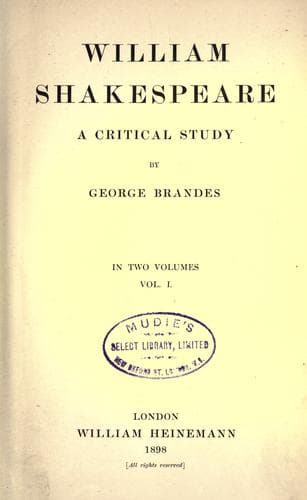
William Shakespeare: A Critical StudyBrandes, Georg
General
William Shakespeare: A Critical Study
Brandes, Georg
Shakespeare, William, 1564-1616 -- Criticism and interpretation
Old Queen Bess can scarcely have been a great judge of art, or she
would not have conceived the extravagant notion of wanting to see
Falstaff in love; she would have understood that if there was anything
impossible to him it was this. She would also have realised that
his figure was already a rounded whole and could not be reproduced.
It is true that in the Epilogue to _Henry IV_. (which, however,
is probably not by Shakespeare) a continuation of the history is
promised, in which, "for anything I know, Falstaff shall die of a
sweat, unless already he be killed with your hard opinions;" (but no
such continuation is to be found in _Henry V_.) evidently because
Shakespeare felt that Falstaff had played out his part. Neither is _The
Merry Wives_ the promised continuation, for Falstaff does not die, and
the action is conceived as an earlier episode in his life, though it is
entirely removed from its historical setting and brought forward into
the poet's own time, so unequivocally that there is even in the fifth
act a direct mention of "our radiant queen" in Windsor Castle.
The poet must have set himself unwillingly to the fulfilment of the
"radiant queen's" barbarous wish, and tried to make the best of
a bad business. He was compelled entirely to ruin his inimitable
Falstaff, and degrade the fat knight into an ordinary avaricious,
wine-bibbing, amatory old fool. Along with him, he resuscitated the
whole merry company from _Henry V_., who had all come to an unpleasant
end--Bardolph, Pistol, Nym, and Dame Quickly--making the men repeat
themselves with a difference, endowing Pistol with the splendid phrase,
"The world's mine oyster, which I with sword will open," and giving to
Dame Quickly softened and more commonplace lineaments. From the Second
Part of _Henry IV._ too, he introduces Justice Shallow, placing him in
a less friendly relation to Falstaff, and giving him a highly comic
nephew, Slender, who, in his vanity and pitifulness, is like a first
sketch for Sir Andrew Aguecheek in _Twelft Night_.
Public-domain text, read in full here on John Shaqi.
Reviews
Reviews
No reviews yet
Be the first to share your thoughts on this work.
Elsewhere in the archive
Join the Discussion
Join the discussion
Sign in to leave a comment or review.
Sign InorCreate an account