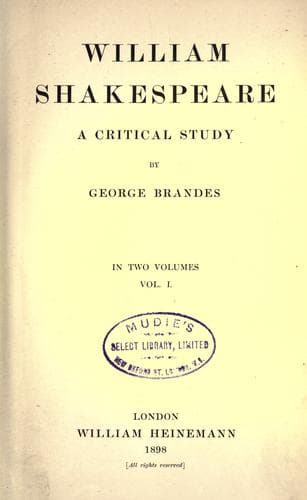
William Shakespeare: A Critical StudyBrandes, Georg
General
William Shakespeare: A Critical Study
Brandes, Georg
Shakespeare, William, 1564-1616 -- Criticism and interpretation
His task was now to entertain a queen and a court "with their hatred of
ideas, their insensibility to beauty, their hard, efficient manners,
and their demand for impropriety."[1] As it amused the London populace
to see kings and princes upon the stage, so it entertained the Queen
and her court to have a glimpse into the daily life of the middle
classes, so remote from their own, to look into their rooms, and hear
their chat with the doctor and the parson, to see a picture of the
prosperity and contentment which flourished at Windsor right under the
windows of the Queen's summer residence, and to witness the downright
virtue and merry humour of the red-cheeked, buxom townswomen. Thus
was the keynote of the piece determined. Thus it became more prosaic
and bourgeois than any other play of Shakespeare's. _The Merry Wives_
is indeed the only one of his works which is almost entirely written
in prose, and the only one of his comedies in which, the scene being
laid in England, he has taken as his subject the contemporary life of
the English middle classes. It is not quite unlike the more farcical
of Molière's comedies, which also were often written with an eye to
royal and courtly audiences. All the more significant is the fact
that Shakespeare has found it impossible to content himself with
thus dwelling on the common earth, and has introduced at the close
a fairy-dance and fairy-song, as though from the _Midsummer Night's
Dream_ itself, executed, it is true, by children and young girls
dressed up as elves, but preserving throughout the air and style of
genuine fairy scenes.
Shakespeare had just been trying his hand in _Henry V._ at writing the
broken English spoken by a Welshman and by a Frenchman. He knew that
at court, where people prided themselves on the purest pronunciation
of their mother-tongue, he would find an audience exceedingly alive
to the comic effects thus obtained, and he therefore, while he was in
the vein, introduced into this hasty and occasional production two
not unkindly caricatures--the Welsh priest, Sir Hugh Evans, in whom
he perhaps immortalised one of his Stratford schoolmasters, and the
French Doctor Caius, a thoroughly farcical eccentric, who pronounces
everything awry.
The hurry with which Shakespeare wrote this comedy has led him into
some confusion as to the process of time. In Act iii. 4, when Dame
Quickly is sent to Falstaff to make a second appointment with him, it
is the afternoon of the second day; in the following scene, when she
comes to him, it is the morning of the third day. But this haste has
also given the play an unusually dramatic swing and impetus; it is
quite free from the episodes in which the poet is at other times apt to
loiter.
Public-domain text, read in full here on John Shaqi.
Reviews
Reviews
No reviews yet
Be the first to share your thoughts on this work.
Elsewhere in the archive
Join the Discussion
Join the discussion
Sign in to leave a comment or review.
Sign InorCreate an account