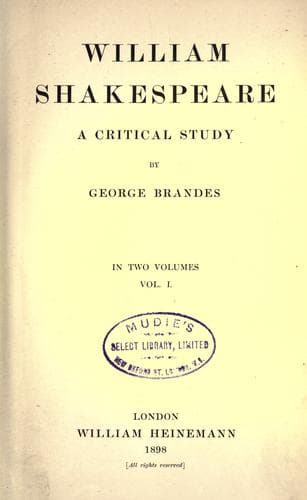
William Shakespeare: A Critical StudyBrandes, Georg
General
William Shakespeare: A Critical Study
Brandes, Georg
Shakespeare, William, 1564-1616 -- Criticism and interpretation
It is, then, in Shakespeare's Timon, of many years later, that we can
alone find an instructive parallel to Alceste. Alceste's nature is
keenly logical, classically French; it consists of sheer uncompromising
sincerity and pride, without sensibility and without melancholy.
The melancholy of Jaques is a poetic dreaminess. He is described to us
(ii. I) before we see him. The banished Duke has just been blessing
the adversity which drove him out into the forest, where he is exempt
from the dangers of the envious court. He is on the point of setting
forth to hunt, when he learns that the melancholy Jaques repines at the
cruelty of the chase, and calls him in that respect as great a usurper
as the brother who drove him from his dukedom. The courtiers have found
him stretched beneath an oak, and dissolved in pity for a poor wounded
stag which stood beside the brook, and "heaved forth such groans That
their discharge did stretch his leathern coat Almost to bursting."
Jaques, they continue, "moralised this spectacle into a thousand
similes:"--
"Then, being there alone,
Left and abandon'd of his velvet friends;
"'Tis right,' quoth he; 'thus misery doth part
The flux of company.' Anon, a careless herd,
Full of the pasture, jumps along by him,
And never stays to greet him. 'Ay,' quoth Jaques,
'Sweep on, you fat and greasy citizens;
'Tis just the fashion: wherefore do you look
Upon that poor and broken bankrupt there?"
His bitterness springs from a too tender sensibility, a sensibility
like that of Sakya Mouni before him, who made tenderness to animals
part of his religion, and like that of Shelley after him, who, in his
pantheism, realised the kinship between his own soul and that of the
brute creation.
Thus we are prepared for his entrance. He introduces himself into the
Duke's circle (ii. 7) with a glorification of the fool's motley. He has
encountered Touchstone in the forest, and is enraptured with him. The
motley fool lay basking in the sun, and when Jaques said to him, "Good
morrow, fool!" he answered, "Call me not fool till heaven have sent me
fortune." Then this sapient fool drew a dial from his pocket, and said
very wisely--
"'It is ten o'clock:
Thus may we see,' quoth he, I how the world wags:
'Tis but an hour ago since it was nine,
And after one hour more 'twill be eleven;
And so from hour to hour we ripe and ripe,
And then from hour to hour we rot and rot,
And thereby hangs a tale.'"
"O noble fool!" Jaques exclaims with enthusiasm. "A worthy fool!
Motley's the only wear."
Public-domain text, read in full here on John Shaqi.
Reviews
Reviews
No reviews yet
Be the first to share your thoughts on this work.
Elsewhere in the archive
Join the Discussion
Join the discussion
Sign in to leave a comment or review.
Sign InorCreate an account