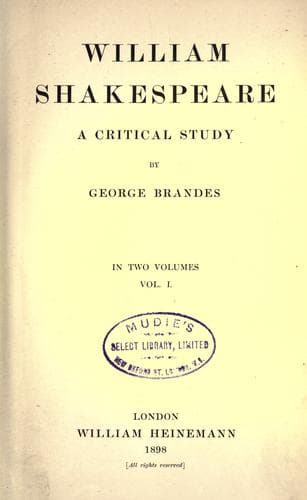
William Shakespeare: A Critical StudyBrandes, Georg
General
William Shakespeare: A Critical Study
Brandes, Georg
Shakespeare, William, 1564-1616 -- Criticism and interpretation
A forged letter, purporting to be written by his noble mistress, is
made to fall into Malvolio's hands, in which she begs for his love, and
instructs him, as a sign of his affection towards her, always to smile,
and to wear cross-gartered yellow stockings. He "smiles his face into
more lines than are in the new map [of 1598] with the augmentation of
the Indies;" he wears his preposterous garters in the most preposterous
fashion. The conspirators pretend to think him mad, and treat him
accordingly. The Clown comes to visit him disguised in the cassock
of Sir Topas the curate. "Well," says the mock priest (not without
intention on the poet's part), when Maria gives him the gown, "I'll put
it on, and I will dissemble myself in't; and I would I were the first
that ever dissembled in such a gown."
It is to Malvolio, too, that the merry and mellow Sir Toby, amid the
applause of the Clown, addresses the taunt:--
"_Sir Toby_. Dost thou think, because thou art virtuous,
there shall be no more cakes and ale?
"_Clown_. Yes, by Saint Anne; and ginger shall be hot i' the
mouth too."
In these words, which were one day to serve as a motto to Byron's _Don
Juan_, there lies a gay and daring declaration of rights.
_Twelfth Night, or What you Will_, must have been written in 1601,
for in the above-mentioned diary kept by John Manningham, of the
Middle Temple, we find this entry, under the date February 2, 1602:
"At our feast wee had a play called Twelve Night, or what you will,
much like the commedy of errores, or Menechmi in Plautus, but most
like and neere to that in Italian called _Inganni_. A good practise
in it to make the steward beleeve his lady widdowe was in love with
him," &c. That the play cannot have been written much earlier is
proved by the fact that the song, "Farewell, dear heart, since I must
needs be gone," which is sung by Sir Toby and the Clown (ii. 3), first
appeared in a song-book (_The Booke of Ayres_) published by Robert
Jones, London, 1601. Shakespeare has altered its wording very slightly.
In all probability _Twelfth Night_ was one of the four plays which
were performed before the court at Whitehall by the Lord Chamberlain's
company at Christmastide, 1601-2, and no doubt it was acted for the
first time on the evening from which it takes its name.
Among several Italian plays which bore the name of _Gl'Inganni_ there
is one by Curzio Gonzaga, published in Venice in 1592, in which a
sister dresses herself as her brother and takes the name of Cesare--in
Shakespeare, Cesario--and another, published in Venice in 1537, the
action of which bears a general resemblance to that of _Twelfth Night_.
In this play, too, passing mention is made of one "Malevolti," who may
have suggested to Shakespeare the name Malvolio.
Public-domain text, read in full here on John Shaqi.
Reviews
Reviews
No reviews yet
Be the first to share your thoughts on this work.
Elsewhere in the archive
Join the Discussion
Join the discussion
Sign in to leave a comment or review.
Sign InorCreate an account