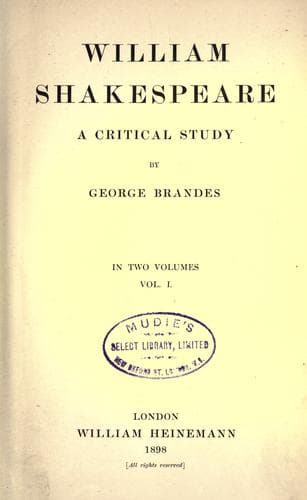
William Shakespeare: A Critical StudyBrandes, Georg
General
William Shakespeare: A Critical Study
Brandes, Georg
Shakespeare, William, 1564-1616 -- Criticism and interpretation
The indictment did not press too severely upon Essex, did not as yet
seek to discover treasonable motives for his inactivity in Ireland, but
simply dwelt upon his disobedience to the Queen's commands, and the
dangerous and dishonourable agreement with Tyrone. Francis Bacon had
not been allotted any part in the proceedings; but on his writing to
the Queen and expressing his desire to serve her in this conjuncture,
he was assigned the quite subordinate task of calling Essex to account
for his indiscretion in accepting the dedication, in unbefitting
terms, of a political pamphlet written by a certain Dr. Hayward. Bacon
exceeded his instructions by dwelling at length on certain passionate
expressions in a letter from Essex to the Lord Keeper, in which he had
spoken of the hardness of the Queen's heart and compared her princely
wrath to a tempest. A man who was less nervously anxious to retain the
Queen's favour would have declined this commission on the ground of his
close relations with Essex; Bacon begged for it, went farther than it
required him to go, and is scarcely to be believed when he afterwards,
in his _Apology_, represents himself as actuated by the wish ultimately
to be of service to Essex with the Queen. Still, he evidently had not
ceased to regard a reconciliation between Elizabeth and Essex as the
most probable result, and he may perhaps have done his best in private
conversations to soften the Queen's resentment.
The sentence passed by the Lord Keeper was the not very severe one that
Essex should, in the meantime, be deprived of all his offices, and
remain a prisoner in Essex House "till it shall please her Majesty to
release both this and all the rest."
Bacon, who still did not think Essex irretrievably lost, now tried,
in a carefully worded letter to him, to explain his attitude, and at
once received from his magnanimous friend a forgiveness which was
scarcely deserved. Bacon declared that, next to the interests of the
Queen and the country, those of Essex always lay nearest his heart;
and he now composed two documents: first, a very judicious letter,
which Essex was partly to re-write and then to send to the Queen,
and next a fictitious letter, a masterpiece of diplomacy, purporting
to have been written by his brother, Anthony Bacon, Essex's faithful
adherent, to Essex himself. This letter, and Essex's reply to it, which
prove to admiration Bacon's talent for reproducing the styles of two
such different men, were to be copied by them respectively, and to be
brought to the knowledge of the Queen, on whom they would no doubt
produce the desired impression. With Machiavellian subtlety, these
letters are carefully framed so as to place Francis Bacon himself in
the light which should most appeal to the Queen: Essex is represented
as regarding him as entirely won over to her side, and Anthony
expresses the hope that she will show him the favour he has deserved
"for that he hath done and suffered."
Public-domain text, read in full here on John Shaqi.
Reviews
Reviews
No reviews yet
Be the first to share your thoughts on this work.
Elsewhere in the archive
Join the Discussion
Join the discussion
Sign in to leave a comment or review.
Sign InorCreate an account