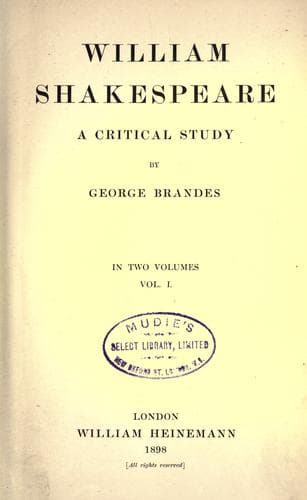
William Shakespeare: A Critical StudyBrandes, Georg
General
William Shakespeare: A Critical Study
Brandes, Georg
Shakespeare, William, 1564-1616 -- Criticism and interpretation
The circumstances of Essex's condemnation were of course not known in
the London of those days so minutely as we now know them. But we see,
as already indicated, that public opinion turned vehemently against
Bacon, regarding and despising him as the traitor to his lord who,
more than any one else, had brought about his unhappy end. We see
that Raleigh, in spite of his greatness, now became one of the most
unpopular men in England; and we observe that, notwithstanding all
that was done to disparage him in the general regard, Essex's memory
continued to be idolised by the great mass of the people.
If we now inquire in what relation Shakespeare stood to these events
which so absorbed the English people, it seems more than probable that
he, who had so recently been so intimately associated with Southampton,
and cannot therefore have been very far from Essex, followed the
accused with his sympathy, felt a lively resentment towards their
enemies, and took their fate much to heart. And when we observe that
just at this juncture a revolution occurs in Shakespeare's hitherto
cheerful habit of mind, and that he begins to take ever gloomier views
of human nature and of life, we cannot but recognise the probability
that grief for the fate which had overtaken Essex, Southampton, and
their fellows, was one of the sources of his growing melancholy.
[1] Compare _Dictionary of National Biography_, Robert Devereux;
Spedding, _Letters and Life of Francis Bacon_, ii. 190-374; Edwin
Abbott, _Francis Bacon, an Account of his Life and Works_, pp. 53-82;
Macaulay, _Lord Bacon_; Gosse, _Raleigh_.
V
_THE DEDICATION OF THE SONNETS_
We naturally looked for one source of his henceforth deepening
melancholy in outward events, in the political drama which reached its
crisis and catastrophe in 1601; but it is still more imperative that we
should look into his private and personal experiences for the ultimate
cause of the revolution in his soul. We must inquire what light his
works throw upon his private circumstances and state of mind at this
period.
Public-domain text, read in full here on John Shaqi.
Reviews
Reviews
No reviews yet
Be the first to share your thoughts on this work.
Elsewhere in the archive
Join the Discussion
Join the discussion
Sign in to leave a comment or review.
Sign InorCreate an account