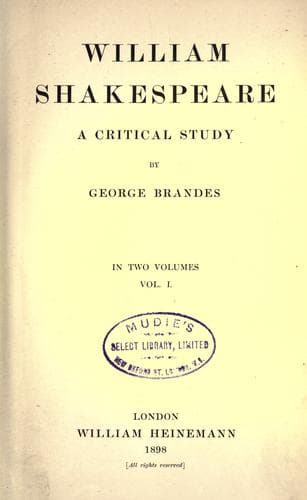
William Shakespeare: A Critical StudyBrandes, Georg
General
William Shakespeare: A Critical Study
Brandes, Georg
Shakespeare, William, 1564-1616 -- Criticism and interpretation
Now, we find among Shakespeare's works one which, more than any other,
enables us to look into his inmost soul--I mean his Sonnets. It is
to these remarkable poems that we must mainly address ourselves for
the information we require. Public events may, indeed, cast a certain
measure of light or shadow over a man's inward world of thought and
feeling; but they are never the efficient factors in determining the
happiness or melancholy of his fundamental mood. If he has personal
reasons for feeling that fate is against him, the utmost serenity in
the political atmosphere will not dissipate his gloom; and, conversely,
if a deep joy abides within him, and he has personal reasons for
feeling himself favoured by fortune, then public discontent will be
powerless to disturb the harmony in his soul. But his depression will,
of course, be doubly severe if public events and private experiences
combine to cast a gloom over his mind.
Shakespeare's "sugred Sonnets" are first mentioned in the well-known
passage in Meres's _Palladis Tamia_ (1598), where they are spoken of as
passing from hand to hand "among his private friends." In the following
year the two important Sonnets now numbered cxxxviii. and cxliv. were
printed (with readings subsequently revised) in a collection of poems
named _The Passionate Pilgrim_, dishonestly published, and falsely
attributed to Shakespeare, by a bookseller named Jaggard. For the next
ten years we find no mention of Sonnets by Shakespeare, until, in
1609, a bookseller named Thomas Thorpe issued a quarto book entitled
_Shakespeares Sonnets. Neuer before Imprinted_--an edition which the
poet himself certainly cannot have revised for the press, but which may
possibly have been printed from an authentic manuscript.
To this first edition is prefixed a dedication, written by the
bookseller in the most contorted style, which has given rise to
theories and conjectures without number. It runs as follows:--
TO . THE . ONLIE . BEGETTER . OF
THESE . INSVING . SONNETS .
MR . W . H . ALL . HAPPINESSE .
AND . THAT . ETERNITIE .
PROMISED .
BY .
OVR . EVER-LIVING . POET .
WISHETH .
THE . WELL-WISHING .
ADVENTVRER . IN .
SETTING .
FORTH .
T . T .
Public-domain text, read in full here on John Shaqi.
Reviews
Reviews
No reviews yet
Be the first to share your thoughts on this work.
Elsewhere in the archive
Join the Discussion
Join the discussion
Sign in to leave a comment or review.
Sign InorCreate an account