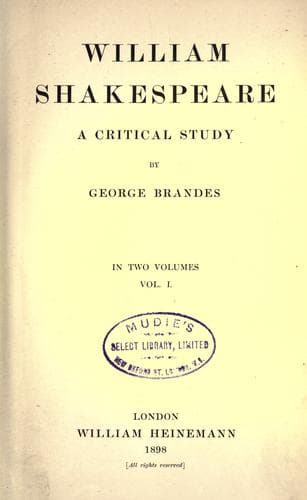
William Shakespeare: A Critical StudyBrandes, Georg
General
William Shakespeare: A Critical Study
Brandes, Georg
Shakespeare, William, 1564-1616 -- Criticism and interpretation
The meaning of the signature is clear enough, since "A booke called
Shakespeare's Sonnets" was entered in the Stationers' Register on
May 20, 1609, under the name of Thomas Thorpe. On the other hand,
throughout this century and the last, there has been no end to the
discussion as to what is meant by "onlie begetter" (only producer,
or only procurer, or only inspirer?); and numberless have been the
attempts to identify the "Mr. W. H." who is so designated. While
the far-fetched expression "begetter" has been subjected to equally
far-fetched interpretations, the most impossible guesses have been
hazarded as to the initials W. H., and the most incredible conjectures
put forward as to the person to whom the Sonnets are addressed.
Strange as it may seem, it is nevertheless the fact, that during
the first eighty years of the eighteenth century the Sonnets were
taken as being all addressed to one woman, all written in honour of
Shakespeare's mistress. It was not till 1780 that Malone and his
friends declared that more than one hundred of the poems were addressed
to a man. This view of the matter, however, did not even then command
general assent, and so late as 1797 Chalmers seriously maintained
that all the Sonnets were addressed to Queen Elizabeth, who was also,
he believed, the inspirer of Spenser's famous _Amoretti_, in reality
addressed to the lady who afterwards became his wife. Not until the
beginning of this century did people in general understand, what
Shakespeare's contemporaries can certainly never have doubted, that the
first hundred and twenty-six Sonnets are directed to a young man.
It now followed almost of necessity that this young man should be
identified with the "Mr. W. H." who is described as the "onlie
begetter" of the poems. The second group, indeed, is addressed to a
woman; but the first group is much the larger, and follows immediately
upon the dedication.
Some have taken the word "begetter" to signify the man who procured the
manuscript for the bookseller, and have conjectured that the initials
are those of William Hathaway, a brother-in-law of Shakespeare's
(Neil, Elze). Dr. Farmer last century advanced the claims of William
Hart, the poet's nephew, who, as was afterwards discovered, was not
born until 1600. The mere fact that, by a whim or oversight of which
there are many other examples in the first edition, the word "hues,"
in Sonnet xx., is printed in italics with a capital and spelt _Hews_,
led Tyrwhitt to assume the existence of an otherwise unknown Mr.
William Hughes, to whom he supposed the Sonnets to have been addressed.
People have even been found to maintain that "Mr. W. H." referred to
Shakespeare himself, some taking the "H." to be a mere misprint for
"S.," others holding that the initials meant "Mr. William Himself"
(Barnstorff).
Public-domain text, read in full here on John Shaqi.
Reviews
Reviews
No reviews yet
Be the first to share your thoughts on this work.
Elsewhere in the archive
Join the Discussion
Join the discussion
Sign in to leave a comment or review.
Sign InorCreate an account