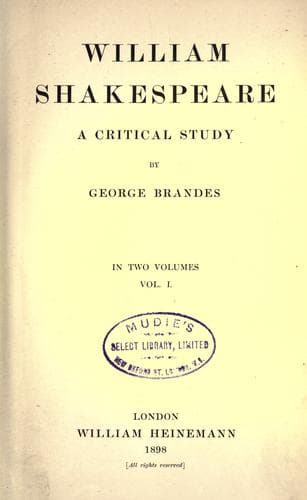
William Shakespeare: A Critical StudyBrandes, Georg
General
William Shakespeare: A Critical Study
Brandes, Georg
Shakespeare, William, 1564-1616 -- Criticism and interpretation
Serious and competent critics for a long time inclined to the opinion
that the "W. H." was a transposition of "H. W.," and represented none
other than Henry Wriothesley, Earl of Southampton, whose close relation
to the poet had long been known, and to whom his two narrative poems
had been dedicated. This theory was held by Drake and Gervinus. But so
early as 1832, Boaden advanced some objections to this view. He urged
that Southampton never possessed the personal beauty incessantly dwelt
upon in these poems. Finally, the Sonnets fit neither his age, nor his
character, nor his history, full of movement, activity, and adverse
fortune, to which no smallest allusion appears.
There is not the slightest doubt that these poems are addressed to a
patron of rank; but our knowledge of the history of Shakespeare is so
inconsiderable, that with regard to his patrons at the court, we have
nothing to judge from but the dedications of Venus and of Lucrece to
Southampton, and the dedication of the First Folio to Lords Pembroke
and Montgomery, in which reference is made to the favour they had
always shown these plays and their author, while he was alive. Bright
and Boaden had already, in 1819 and 1832 respectively, advanced the
opinion that Pembroke was the hero of the Sonnets. This view was shared
by almost every one (Charles Armitage, Brown Hallan, Massey, Henry
Brown, Minto, W. M. Rossetti), and towards the end of the nineteenth
century this opinion could be considered as having established itself,
since it was concurred in by the chief Shakespeare students (Dowden),
and seemed to have obtained its final confirmation in the penetrating
criticisms of Thomas Tyler (1890). All the above-mentioned authors
agree about the fact, that there is only one person whose age, history,
appearance, virtues, and vices accord in every respect with those of
the young man to whom the Sonnets are addressed, just as his initials
agree with those of the "Mr. W. H." to whom they are dedicated,
and that is the young William Herbert, who in 1601 became Earl of
Pembroke. Born on April 8, 1580, he came to London in the autumn of
1597 or spring of 1598, and very soon, in all probability, made the
acquaintance of Shakespeare, whose patron, as the first folio edition
of the dramas prove, he remained until the poet's death.
Public-domain text, read in full here on John Shaqi.
Reviews
Reviews
No reviews yet
Be the first to share your thoughts on this work.
Elsewhere in the archive
Join the Discussion
Join the discussion
Sign in to leave a comment or review.
Sign InorCreate an account