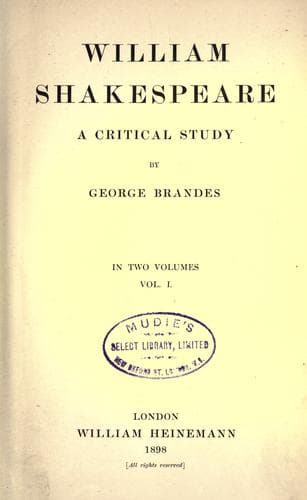
William Shakespeare: A Critical StudyBrandes, Georg
General
William Shakespeare: A Critical Study
Brandes, Georg
Shakespeare, William, 1564-1616 -- Criticism and interpretation
The way by which we arrive at William Herbert is this: The Sonnets
cxxxv. and cxxxvi. as well as cxliii. contain plays on the word _will_,
and the name _Will_, obscure as they are, they show that the friend
whom the Sonnets glorify had the same Christian name as Shakespeare.
This was true of Pembroke, but not of Southampton, whose Christian name
was Henry. Shakespeare's Sonnets are not isolated poems. Though we are
not certain whether the order of the Sonnets in the original edition
is the sequence chosen by the poet himself, still it is evident that
they stand in an intimate relation to each other, a thought or motive
suggested in one being developed more at length in the next or one of
the subsequent Sonnets. The grouping does not seem to be arbitrary;
at any rate, it is so far careful that all attempts to alter it have
only rendered the poems more obscure. The first seventeen Sonnets, for
example, form a closely interwoven group; in all of them, the friend
is exhorted not to die unmarried, but to leave the world an heir to
his beauty, which must otherwise fade and perish with him. Sonnets
c.-cxxvi., which are inseparably connected, turn on the reunion of two
friends after a coldness or misunderstanding has for a time severed
them. Finally, Sonnets cxxvii.-clii. are all addressed, not to a
friend, but to a mistress, the Dark Lady whose relation to the two
friends has already formed the subject of earlier Sonnets.
Sonnet cxliv.--one of the most interesting, inasmuch it depicts
in straightforward terms the poet's situation between friend and
mistress--had already appeared, as above mentioned, in _The Passionate
Pilgrim_ (1599). It characterises the friend as the poet's "better
angel," the mistress as his "worser spirit," and expresses the painful
suspicion that the friend is entangled in the Dark Lady's toils--
"I guess one angel in another's hell;"
so that both at once are lost to him, he through her and she through
him.
But precisely the same theme is treated in Sonnet xl., which turns on
the fact that the friend has robbed Shakespeare of his "love." These
two Sonnets must thus be of the same date; and from Sonnet xxxiii.,
which relates to the same circumstances, we see that the friendship had
existed only a very short time when it was overshadowed by the intrigue
between the friend and the mistress:--
"But out, alack! he was but one hour mine."
Public-domain text, read in full here on John Shaqi.
Reviews
Reviews
No reviews yet
Be the first to share your thoughts on this work.
Elsewhere in the archive
Join the Discussion
Join the discussion
Sign in to leave a comment or review.
Sign InorCreate an account