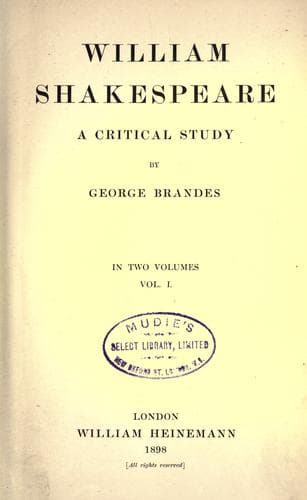
William Shakespeare: A Critical StudyBrandes, Georg
General
William Shakespeare: A Critical Study
Brandes, Georg
Shakespeare, William, 1564-1616 -- Criticism and interpretation
After the accession of James, Pembroke immediately took a high position
at the new Court. Before the year 1603 was out, he was a Knight of
the Garter, and had entertained the King at Wilton. He rose from one
high post to another, until in 1615 he became Lord Chamberlain; but
he continued to the last the dissipated life of his youth. He devoted
large sums of money to the exploration and colonisation of America.
Places were named after him in the Bermudas and Virginia. In 1614,
morever, he became a member of the East India Company.
He opposed the Spanish Alliance, and was no friend to the King's
foreign policy. He is thought to have instigated in some measure the
attack on the Mexico fleet for which Raleigh paid so dear. He was an
opponent of Bacon as Lord Chancellor, and in 1621 advocated an inquiry
into the charges of corruption which were brought against him; but
afterwards, like Southampton, displayed great moderation, and spoke
strongly against the proposal to deprive Bacon of his peerage.
He stood by the King's deathbed in March 1625, had a serious illness in
1626, and died in April 1630 "of an apoplexy after a full and cheerful
supper." Donne in 1660 published some poems.
[1] Hermann Conrad in _Preussische Jahrbücher_, February 1895.
Under the pseudonym of Hermann Isaac in _Jahrbuch der Deutschen
Shakespeare-Gesellschaft_, vol. xix. p. 176.
[2] I do not find that Mr. G. A. Leigh has succeeded in identifying the
rival poet with Tasso (_Westminster Review_, February 1897).
VI
_THE "DARK LADY" OF THE SONNETS--MARY FITTON_
In speaking of _Love's Labours Lost_, I remarked that it was not
difficult to distinguish the original text of the comedy from the
portions added and altered during the revision of 1598; and I cited
(p. 38) several instances in which the distinction was clear. Especial
emphasis was laid on the fact that Biron's (or, as the context shows,
Biron-Shakespeare's) rapturous panegyrics of love in the fourth act
belong to the later date.
At another place (p. 83) it was pointed out that the two Rosalines of
_Love's Labour's Lost_ (end of the third act) and of _Romeo and Juliet_
(ii. 4) were in all probability drawn from the same model, since she is
in both places described as a blonde with black eyes. In the original
text of _Love's Labour's Lost_ (Act iii.) she is expressly called--
"A whitely wanton with a velvet brow,
With two pitch balls stuck in her face for eyes."
All the more surprising must it seem that during the revision the poet
quite obviously had before his eyes another model, repeatedly described
as "black," whose dark complexion indeed, so uncommon and un-English
that it was apt to be thought ugly, is insisted upon as strongly as
that of the "Dark Lady" in the Sonnets. Immediately before Biron bursts
forth into his great hymn to Eros, in which Shakespeare so clearly
makes him his mouthpiece, the King banters him as to the murky hue of
the object of his adoration:--
Public-domain text, read in full here on John Shaqi.
Reviews
Reviews
No reviews yet
Be the first to share your thoughts on this work.
Elsewhere in the archive
Join the Discussion
Join the discussion
Sign in to leave a comment or review.
Sign InorCreate an account