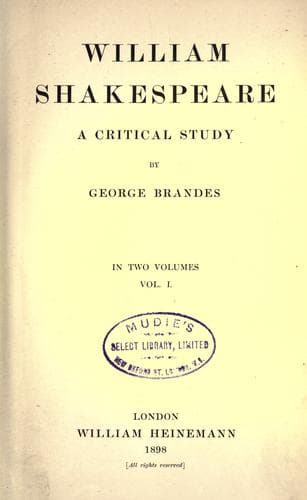
William Shakespeare: A Critical StudyBrandes, Georg
General
William Shakespeare: A Critical Study
Brandes, Georg
Shakespeare, William, 1564-1616 -- Criticism and interpretation
"_King_. By heaven, thy love is black as ebony.
_Biron_. Is ebony like her? O wood divine!
A wife of such wood were felicity.
O! who can give an oath? where is a book?
That I may swear beauty doth beauty lack,
If that she learn not of her eye to look:
No face is fair, that is not full so black.
_King_. O paradox! Black is the badge of hell,
The hue of dungeons, and the scowl of night;
And beauty's crest becomes the heavens well."
Biron's answer to this is highly remarkable; for it is exactly what
Shakespeare himself says, in Sonnet cxxvii., to the advantage of his
dark beauty:--
"_Biron_. Devils soonest tempt, resembling spirits of light.
O! if in black my lady's brows be deck'd,
It mourns, that painting, and usurping hair,
Should ravish doters with a false aspect;
And therefore is she born to make black fair.
Her favour turns the fashion of the days;
For native blood is counted painting now,
And therefore red, that would avoid dispraise,
Paints itself black, to imitate her brow."
The Sonnet runs thus:--
"In the old age black was not counted fair,
Or if it were, it bore not beauty's name;
But now is black beauty's successive heir,
And beauty slander'd with a bastard shame;
For since each hand hath put on nature's power,
Fairing the foul with art's false borrow'd face,
Sweet beauty hath no name, no holy bower,
But is profan'd, if not lives in disgrace.
Therefore my mistress' eyes are raven black,
Her eyes so suited, and they mourners seem
At such, who, not born fair, no beauty lack,
Slandering creation with a false esteem:
Yet so they mourn, becoming of their woe,
That every tongue says, beauty should look so."
It appears, then, that the dark beauty in _Love's Labour's Lost_ must
also have had a living model; and when we observe that the revision, as
the title-page tells us, took place when the comedy was to be presented
before her Highness at Christmas 1597, and further, that the dark
Rosaline in the play is maid-of-honour to a princess who is called,
in words strongly suggesting a passing compliment to the Queen, "a
gracious moon"--we can scarcely avoid the conclusion that the beautiful
brunette must have been one of the Queen's ladies, and that the whole
end of the fourth act was addressed to her over the heads of the
uninitiated spectators. Who she was, moreover, we can now conjecture
with tolerable security. We know quite well which of the Queen's
ladies brought Pembroke into disgrace, and we are no less certain that
the lady who enthralled Pembroke was the black-eyed brunette whom
Shakespeare, in his own words, loved to "distraction" and to "madding
fever."
Public-domain text, read in full here on John Shaqi.
Reviews
Reviews
No reviews yet
Be the first to share your thoughts on this work.
Elsewhere in the archive
Join the Discussion
Join the discussion
Sign in to leave a comment or review.
Sign InorCreate an account