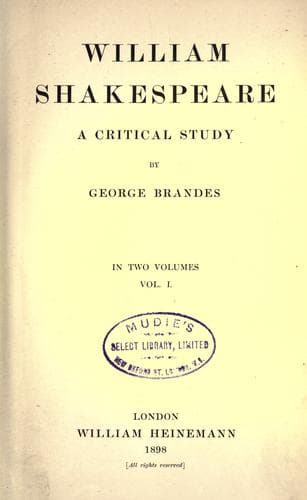
William Shakespeare: A Critical StudyBrandes, Georg
General
William Shakespeare: A Critical Study
Brandes, Georg
Shakespeare, William, 1564-1616 -- Criticism and interpretation
But the poems thus set apart form but a small minority of the
collection. In all the others the waves of feeling run high, and it
may be said in general that the deeper the sentiment and the stronger
the emotion they express, the more admirable is their force of diction
and their marvellous melody. There are Sonnets whose musical quality
is unsurpassed by any of the songs introduced into the plays, or even
by the most famous and beautiful speeches in the plays themselves.
The free and lax form he had adopted was of evident advantage to
Shakespeare. The triple and quadruple rhymes, which in Italian involve
scarcely any difficulty or constraint, would have proved very hampering
in English. As a matter of fact, Shakespeare has been able to follow
out every inspiration unimpeded by the shackles of an elaborate
rhyme-scheme, and has achieved a rare combination of terseness
and harmony in the expression of sorrow, melancholy, anguish, and
resignation. Nothing can be more melodious than the opening of Sonnet
xl., quoted above, or these lines from Sonnet lxxxvi.:--
"Was it the proud full sail of his great verse,
Bound for the prize of all-too-precious you,
That did my ripe thoughts in my brain inhearse,
Making their tomb the womb wherein they grew?"
And how moving is the earnestness of Sonnet cxvi., on faith in love:--
"Let me not to the marriage of true minds
Admit impediments. Love is not love
Which alters when it alteration finds,
Or bends with the remover to remove:
O, no! it is an ever-fixèd mark,
That looks on tempests, and is never shaken;
It is the star to every wandering bark,
Whose worth's unknown, although his height be taken."
Shakespeare's Sonnets are for the general reader the most inaccessible
of his works, but they are also the most difficult to tear oneself away
from. "With this key Shakespeare unlocked his heart," says Wordsworth;
and some people are repelled from them by the _Menschliches_, or, as
they think, _Allzumenschliches_, which is there revealed. They at
any rate hold Shakespeare diminished by his openness. Browning, for
example, thus retorts upon Wordsworth:--
"'With this same key
Shakespeare unlocked his heart' once more!
Did Shakespeare? If so, the less Shakespeare he."
Public-domain text, read in full here on John Shaqi.
Reviews
Reviews
No reviews yet
Be the first to share your thoughts on this work.
Elsewhere in the archive
Join the Discussion
Join the discussion
Sign in to leave a comment or review.
Sign InorCreate an account