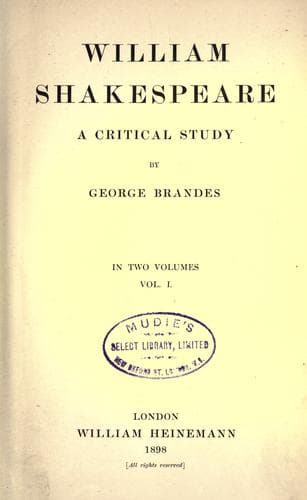
William Shakespeare: A Critical StudyBrandes, Georg
General
William Shakespeare: A Critical Study
Brandes, Georg
Shakespeare, William, 1564-1616 -- Criticism and interpretation
The reader who can reconcile himself to the fact that great geniuses
are not necessarily models of correctness will pass a very different
judgment. He will follow with eager interest the experiences which
rent and harrowed Shakespeare's soul. He will rejoice in the insight
afforded by these poems, which the crowd ignores, into the tempestuous
emotional life of one of the greatest of men. Here, and here alone,
we see Shakespeare himself, as distinct from his poetical creations,
loving, admiring, longing, yearning, adoring, disappointed, humiliated,
tortured. Here alone does he enter the confessional. Here more than
anywhere else can we, who at a distance of three centuries do homage to
the poet's art, feel ourselves in intimate communion, not only with the
poet, but with the man.
[1] For instance, in Sonnet xxiii.:--
"O let my books be then the eloquence
And dumb presagers of my speaking breast,
Who plead for love, and look for recompense."
And in Sonnet xxvi.:--
"Lord of my love, to whom in vassalage
Thy merit hath my duty strongly knit.
[2] Ludwig von Scheffler: _Michel Angelo. Eine
Renaissancestudie_, 1892.
[3] "E se io non àrò l'arte del navicare per l'onde del mare
del vostro valoroso ingegno, quello mi scuserà, nè si sdegnierà del
mio disaguagliarsigli, nè desiderrà da me quello che in me non è:
perchè chi è solo in ogni cosa, in cosa alcuna non può aver compagni.
Però la vostra Signoria, luce del secol nostro unica al mondo, non puo
sodisfarsi di opera d'alcuno altro, non avendo pari nè simile à sè,"
&c.
[4] "E io non nato, o vero nato morto mi reputerei, e direi in
disgrazia del cielo e della terra, se per la vostra non avessi visto e
creduto vostra Signoria accettare volentieri alcune delle opere mie."
"Avete data la copia de' sopradetti Madrigali a messer Tomaso ... che
se m'uscissi della mente, credo che súbito cascherei morto."
[5]
"Accio ch'i' abbi, e non già per mie merto,
desiato mio dolce signiore
Per sempre nell' indegnie e pronte braccia."
[6] This line, however, is obviously suggested by the famous passage in
_Macbeth_ (Act v.)--
"My way of life
Is fall'n into the sere, the yellow leaf."
[7] Several passages in the Sonnets suggest that Pembroke must have
conferred substantial gifts upon Shakespeare--for example, that
expression "wealth" in Sonnet xxxvii., "your bounty" in Sonnet liii.,
and "your own dear-purchased right" in Sonnet cxvii.
[8] "Anzi posso prima dimenticare il cibo di ch'io vivo, che nutrisce
solo il corpo infelicemente, che il nome vostro, che nutrisce il corpo
e l'anima, riempiendo l'uno e l'altro di tanta dolcezza, che nè noia nè
timor di morte, mentre la memoria mi vi serba, posso sentire."
[9] _Jahrbuch der deutschen Shakespeare-Gesellschaft_, Band xiii. S.
158.
VIII
_JULIUS CÆSAR--ITS FUNDAMENTAL DEFECT_
Public-domain text, read in full here on John Shaqi.
Reviews
Reviews
No reviews yet
Be the first to share your thoughts on this work.
Elsewhere in the archive
Join the Discussion
Join the discussion
Sign in to leave a comment or review.
Sign InorCreate an account