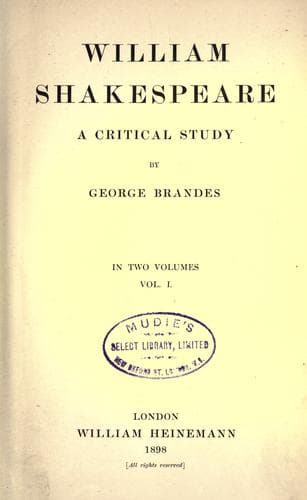
William Shakespeare: A Critical StudyBrandes, Georg
General
William Shakespeare: A Critical Study
Brandes, Georg
Shakespeare, William, 1564-1616 -- Criticism and interpretation
It is afternoon, a little before three o'clock. Whole fleets of
wherries are crossing the Thames, picking their way among the swans
and the other boats, to land their passengers on the south bank of
the river. Skiff after skiff puts forth from the Blackfriars stair,
full of theatre-goers who have delayed a little too long over their
dinner and are afraid of being too late; for the flag waving over the
Globe Theatre announces that there is a play to-day. The bills upon
the street-posts have informed the public that Shakespeare's _Julius
Cæsar_ is to be presented, and the play draws a full house. People
pay their sixpences and enter; the balconies and the pit are filled.
Distinguished and specially favoured spectators take their seats on the
stage behind the curtain. Then sound the first, the second, and the
third trumpet-blasts, the curtain parts in the middle, and reveals a
stage entirely hung with black.
Enter the tribunes Flavius and Marullus; they scold the rabble and
drive them home because they are loafing about on a week-day without
their working-clothes and tools--in contravention of a London police
regulation which the public finds so natural that they (and the poet)
can conceive it as in force in ancient Rome. At first the audience is
somewhat restless. The groundlings talk in undertones as they light
their pipes. But the Second Citizen speaks the name of Cæsar. There are
cries of "Hush! hush!" and the progress of the play is followed with
eager attention.
It was received with applause, and soon became very popular. Of this
we have contemporary evidence. Leonard Digges, in the poem quoted
above (p. 233), vaunts its scenic attractiveness at the expense of Ben
Jonson's Roman plays:--
"So have I seene, when Cesar would appeare,
And on the Stage at halfe-sword parley were
_Brutus and Cassius_: oh how the Audience
Were ravish'd, with what new wonder they went thence,
When some new day they would not brooke a line
Of tedious (though well laboured) _Catiline_."
The learned rejoiced in the breath of air from ancient Rome which met
them in these scenes, and the populace was entertained and fascinated
by the striking events and heroic characters of the drama. A quatrain
in John Weever's _Mirror of Martyrs, or The Life and Death of Sir Iohn
Oldcastle Knight, Lord Cobham,_ tells how
"The many-headed multitude were drawne
By _Brutus_ speech, that _Cæsar_ was ambitious,
When eloquent _Mark Antonie_ had showne
His vertues, who but _Brutus_ then was vicious?"
Public-domain text, read in full here on John Shaqi.
Reviews
Reviews
No reviews yet
Be the first to share your thoughts on this work.
Elsewhere in the archive
Join the Discussion
Join the discussion
Sign in to leave a comment or review.
Sign InorCreate an account