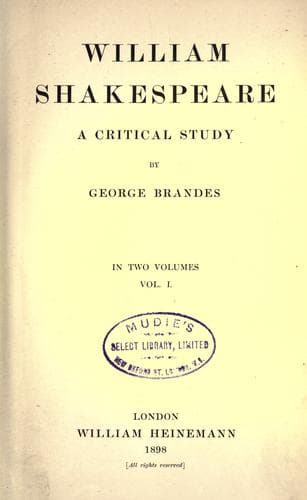
William Shakespeare: A Critical StudyBrandes, Georg
General
William Shakespeare: A Critical Study
Brandes, Georg
Shakespeare, William, 1564-1616 -- Criticism and interpretation
There were, indeed, numerous plays on the subject of Julius Cæsar--they
are mentioned in Gosson's _Schoole of Abuse_, 1579, in _The Third Blast
of Retraite from Plaies_, 1580, in Henslowe's Diary, 1594 and 1602, in
_The Mirrour of Policie_, 1598, &c.--but Weever's words do not apply
to any of those which have come down to us. It can therefore scarcely
be doubted that they refer to Shakespeare's drama; and as the poem
appeared in 1601, it affords us almost decisive evidence as to the date
of _Julius Cæsar_. In all probability, it was in the same year that the
play was written and produced. Weever, indeed, says in his dedication
that his poem was "some two yeares agoe made fit for print;" but even
if this be true, the lines above quoted may quite well have been
inserted later. There are several reasons for believing that _Julius
Cæsar_ can scarcely have been produced earlier than 1601. The years
1599 and 1600 are already so full of work that we can scarcely assign
to them this great tragedy as well; and internal evidence indicates
that the play must have been written about the same time as _Hamlet,_
to which its style offers so many striking resemblances.
The immediate success of the play is proved by this fact, among
others, that it at once called forth a rival production on the same
theme. Henslow notes in his diary that in May 1602, on behalf of Lord
Nottingham's company, he paid five pounds for a drama called _Cæsar's
Fall_ to the poets Munday, Drayton, Webster, Middleton, and another.
It was evidently written to order. And as _Julius Cæsar_, in its
novelty, was unusually successful, so, too, we find it still reckoned
one of Shakespeare's greatest and profoundest plays, unlike the English
"Histories" in standing alone and self-sufficient, characteristically
composed, forming a rounded whole in spite of its apparent scission
at the death of Cæsar, and exhibiting a remarkable insight into Roman
character and the life of antiquity.
What attracted Shakespeare to this theme? And, first and foremost, what
_is_ the theme? The play is called _Julius Cæsar_, but it was obviously
not Cæsar himself that attracted Shakespeare. The true hero of the
piece is Brutus; he it is who has aroused the poet's fullest interest.
We must explain to ourselves the why and wherefore.
Public-domain text, read in full here on John Shaqi.
Reviews
Reviews
No reviews yet
Be the first to share your thoughts on this work.
Elsewhere in the archive
Join the Discussion
Join the discussion
Sign in to leave a comment or review.
Sign InorCreate an account