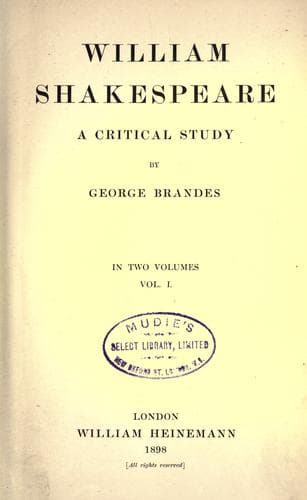
William Shakespeare: A Critical StudyBrandes, Georg
General
William Shakespeare: A Critical Study
Brandes, Georg
Shakespeare, William, 1564-1616 -- Criticism and interpretation
This whole warfare must not be taken too seriously. The worthy
Ben could be at the same time an indignant moralist and a genial
boon-companion. We presently find him taking service afresh with the
very Henslow whom he has just treated with such withering contempt;
and though his attack of 1601 had been met by a most malicious retort
in Marston and Dekker's _Satiromastix_, he, three years afterwards,
accepts the dedication of Marston's _Malcontent_, and in 1605
collaborates with this lately-lampooned colleague and with Chapman in
the comedy of _Eastward Ho!_ One could not but think of the German
proverb, "Pack schlagt sich, Pack vertragt sich," were it not that
Jonson's action at this juncture reveals him in anything but a vulgar
light. Marston and Chapman having been thrown into prison for certain
gibes at the Scotch in this play, which had come to the notice of the
King, and being reported to be in danger of having their noses and
ears cut off, Ben Jonson, of his own free will, claimed his share
in the responsibility and joined them in prison. At a supper which,
after their liberation, he gave to all his friends, his mother clinked
glasses with him, and at the same time showed him a paper, the contents
of which she had intended to mix with his drink in prison if he had
been sentenced to mutilation. She added that she herself would not have
survived him, but would have taken her share of the poison. She must
have been a mother worthy of such a son.
While Ben lay in durance on account of his duel, he had been converted
to Catholicism by a priest who attended him--a conversion at which his
adversaries did not fail to jeer. He does not seem, however, to have
embraced the Catholic dogma with any great fervour, for twelve years
later he once more changes his religion and returns to the Protestant
Church. Equally characteristic of Ben and of the Renaissance is his own
statement, preserved for us by Drummond, that at his first communion
after his reconciliation with Protestantism, in token of his sincere
return to the doctrine which gave laymen, as well as priests access to
the chalice, he drained at one draught the whole of the consecrated
wine.
Not without humour, moreover--to use Jonson's own favourite word--is
his story of the way in which Raleigh's son, to whom he acted as
governor during a tour in France (while Raleigh himself was in
the Tower), took a malicious pleasure in making his mentor dead
drunk, having him wheeled in a wheelbarrow through the streets of
Paris, and showing him off to the mob at every street corner. Ben's
strong insistence on his spiritual dignity was not infrequently
counterbalanced by an extreme carelessness of his personal dignity.
Public-domain text, read in full here on John Shaqi.
Reviews
Reviews
No reviews yet
Be the first to share your thoughts on this work.
Elsewhere in the archive
Join the Discussion
Join the discussion
Sign in to leave a comment or review.
Sign InorCreate an account