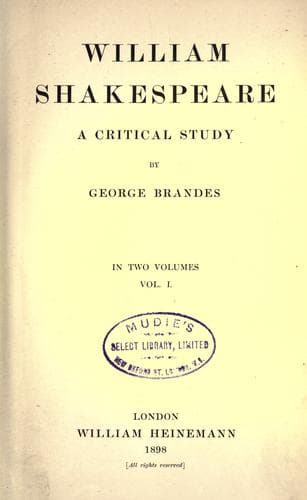
William Shakespeare: A Critical StudyBrandes, Georg
General
William Shakespeare: A Critical Study
Brandes, Georg
Shakespeare, William, 1564-1616 -- Criticism and interpretation
With all his weaknesses, however, he was a sturdy, energetic, and
high-minded man, a commanding, independent, and very comprehensive
intelligence; and from 1598, when he makes his first appearance on
Shakespeare's horizon, throughout the rest of his life, he was, so
far as we can see, the man of all his contemporaries whose name was
oftenest mentioned along with Shakespeare's. In after days, especially
outside England, the name of Ben Jonson has come to sound small enough
in comparison with the name of solitary greatness with which it was
once bracketed; but at that time, although Jonson was never so popular
as Shakespeare, they were commonly regarded in literary circles as the
dramatic twin-brethren of the age. For us it is still more interesting
to remember that Ben Jonson was one of the few with whom we know that
Shakespeare was on terms of constant familiarity, and, moreover, that
he brought to this intercourse a set of definite artistic principles,
widely different from Shakespeare's own. Though his society may
have been somewhat fatiguing, it must nevertheless have been both
instructive and stimulating to Shakespeare, since Ben was greatly his
superior in historical and linguistic knowledge, while as a poet he
pursued a totally different ideal.
Ben Jonson was a great dramatic intelligence. He never, like the other
poets of his time, took this or that novel and dramatised it as it
stood, regardless of its more or less incoherent structure, its more or
less flagrant defiance of topographical, geographical, or historical
reality. With architectural solidity--was he not the step-son of a
master-builder?--he built up his dramatic plan out of his own head,
and, being a man of great learning, he did his best to avoid all
incongruities of local colour. If he is now and then negligent in this
respect--if the characters in _Volpone_ now and then talk as if they
were in London, not in Venice, and those in _The Poetaster_ as if they
were in England, not in Rome--it is because of his satiric purpose, and
not at all by reason of the indifference to such considerations which
characterises all other dramatists of the time, Shakespeare not the
least.
Public-domain text, read in full here on John Shaqi.
Reviews
Reviews
No reviews yet
Be the first to share your thoughts on this work.
Elsewhere in the archive
Join the Discussion
Join the discussion
Sign in to leave a comment or review.
Sign InorCreate an account