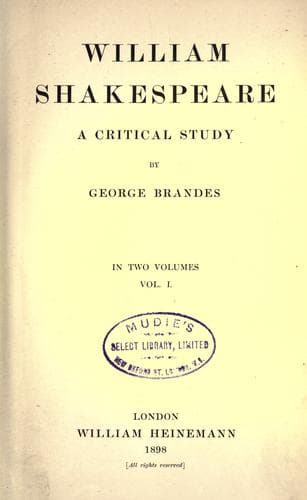
William Shakespeare: A Critical StudyBrandes, Georg
General
William Shakespeare: A Critical Study
Brandes, Georg
Shakespeare, William, 1564-1616 -- Criticism and interpretation
The fundamental contrast between them can be most shortly expressed
in the statement that Ben Jonson accepted the view of human nature
set forth in the classic comedies and the Latin tragedies. He
does not represent it as many-sided, with inward developments and
inconsistencies, but fixes character in typical forms, with one
dominant trait thrown into high relief. He portrays, for example, the
crafty parasite, or the eccentric who cannot endure noise, or the
braggart captain, or the depraved anarchist (Catiline), or the stern
man of honour (Cato)--and all these personalities are neither more nor
less than the labels imply, and act up to their description always and
in all circumstances. The pencil with which he draws is hard, but he
wields it with such power that his best outlines subsist through the
centuries, unforgettable, despite their occasional oddity of design,
in virtue of the indignation with which wickedness and meanness
are branded, and the racy merriment with which the caricatures are
sketched, the farces worked out.
Some of Molière's farces may now and then remind us of Jonson's, but,
as regards the pitiless intensity of the satire, we shall find no
counterpart to his _Volpone_ until we come in our own times to Gogol's
_Revisor_.
The Graces stood by Shakespeare's cradle, not by Jonson's; and yet this
heavy-armed warrior has now and then attained to grace as well--has now
and then given a holiday to his sound systematic intelligence and his
solidly-constructed logic, and, like a true poet of the Renaissance,
soared into the rarer atmosphere of pure fantasy.
He shows himself very much at home in the allegorical masques which
were performed at court festivals; and in the pastoral play _The
Sad Shepherd_ which seems to have been written upon his death-bed,
he proved that even in the purely romantic style he could challenge
comparison with the best writers of his day. Yet it is not in this
sphere that he displays his true originality. It is in his keen and
faithful observation of the conditions and manners of his time, which
Shakespeare left on one side, or depicted only incidentally and
indirectly. The London of Elizabeth lives again in Jonson's plays; both
the lower and higher circles, but especially the lower: the haunters of
taverns and theatres, the men of the riverside and the markets, rogues
and vagabonds, poets and players, watermen and jugglers, bear-leaders
and hucksters, rich city dames, Puritan fanatics and country squires,
English oddities of every class and kind, each speaking his own
language, dialect, or jargon. Shakespeare never kept so close to the
life of the day.
Public-domain text, read in full here on John Shaqi.
Reviews
Reviews
No reviews yet
Be the first to share your thoughts on this work.
Elsewhere in the archive
Join the Discussion
Join the discussion
Sign in to leave a comment or review.
Sign InorCreate an account