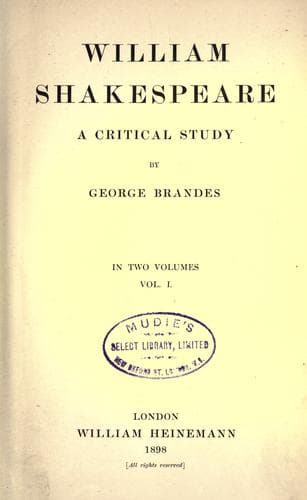
William Shakespeare: A Critical StudyBrandes, Georg
General
William Shakespeare: A Critical Study
Brandes, Georg
Shakespeare, William, 1564-1616 -- Criticism and interpretation
It is especially Johnson's scholarship that must have made his
society full of instruction for Shakespeare. Ben's acquirements were
encyclopædic, and his acquaintance with the authors of antiquity was
singularly complete and accurate. It has often been remarked that he
was not content with an exhaustive knowledge of the leading writers
of Greece and Rome. He knows not only the great historians, poets,
and orators, such as Tacitus and Sallust, Horace, Virgil, Ovid, and
Cicero, but sophists, grammarians, and scholiasts, men like Athenæus,
Libanius, Philostratus, Strabo, Photius. He is familiar with fragments
of Æolic lyrists and Roman epic poets, of Greek tragedies and Roman
inscriptions; and, what is still more remarkable, he manages to make
use of all his knowledge. Whatever in the ancients he found beautiful
or profound or stimulating, that he wove into his work. Dryden says of
him in his "Essay of Dramatic Poesy":--
"The greatest man of the last age (Ben Jonson) was willing
to give place to the ancients in all things: he was not only
a professed imitator of Horace, but a learned plagiary of
all the others; you track him everywhere in their snow. If
Horace, Lucan, Petronius Arbiter, Seneca, and Juvenal had
their own from him, there are few serious thoughts which are
new in him.... But he has done his robberies so openly, that
one may see he fears not to be taxed by any law. He invades
authors like a monarch; and what would be theft in other
poets is only victory in him."
Certain it is that an uncommon learning and an extraordinary memory
supplied him with an immense store of small touches, poetical and
rhetorical details, which he could not refrain from incorporating in
his plays.
Yet his mass of learning was not of a merely verbal or rhetorical
nature; he knew things as well as words. Whatever subject he treats of,
be it alchemy, or witchcraft, or cosmetics in the time of Tiberius, he
handles it with competence and has its whole literature at his fingers'
ends. He thus becomes universal like Shakespeare, but in a different
way. Shakespeare knows, firstly, all that cannot be learnt from books,
and in the second place, whatever can be gleaned by genius from a
casual utterance, an intelligent hint, a conversation with a man of
high acquirements. Besides this, he knows the literature which was at
that time within the reach of a quick-witted and studious man without
special scholarship. Ben Jonson, on the other hand, is a scholar by
profession. He has learnt from books all that the books of his day--for
the most part, of course, the not too numerous survivals of the classic
literatures--could teach a man who made scholarship his glory. He not
only possesses knowledge, but he knows whence he has acquired it; he
can cite his authorities by chapter and paragraph, and he sometimes
garnishes his plays with so many learned references that they bristle
with notes like an academic thesis.
Public-domain text, read in full here on John Shaqi.
Reviews
Reviews
No reviews yet
Be the first to share your thoughts on this work.
Elsewhere in the archive
Join the Discussion
Join the discussion
Sign in to leave a comment or review.
Sign InorCreate an account