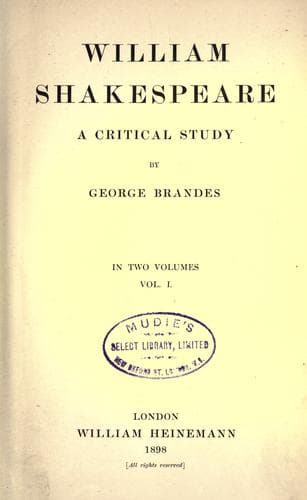
William Shakespeare: A Critical StudyBrandes, Georg
General
William Shakespeare: A Critical Study
Brandes, Georg
Shakespeare, William, 1564-1616 -- Criticism and interpretation
Colossal, coarse-grained, vigorous, and always ready for the fray, with
his gigantic burden of learning, he has been compared by Taine to one
of those war-elephants of antiquity which bore on their backs a whole
fortress, with garrison, armoury, and munitions, and under the weight
of this panoply could yet move as quickly as a fleet-footed horse.
It must have been intensely interesting for their comrades at the
Mermaid to listen to the discussions between Jonson and Shakespeare,
to follow two such remarkable minds, so differently organised and
equipped, when they debated, in jest or earnest, this or that historic
problem, this or that moot point in æsthetics; and no less interesting
is it for us, in our days, to compare their almost contemporaneous
dramatic treatment of Roman antiquity. We might here expect Shakespeare
to have the worst of it, since he, according to Jonson's well-known
phrase, had "small Latine and less Greek;" while Ben was as much
at home in ancient Rome as in the London of his day, and, with his
altogether masculine talent, could claim a certain kinship with the
Roman spirit.
And yet even here Shakespeare stands high above Jonson, who, with all
his learning and industry, lacks his great contemporary's sense for the
fundamental element in human nature, to which the terms good and bad do
not apply, and has, besides, very few of those unforeseen inspirations
of genius which constitute Shakespeare's strength, and make up for all
the gaps in his knowledge. Jonson, moreover, could not modulate into
the minor key, and is thus unable to depict the inmost subtleties of
feminine character.
None the less would it be unjust to make Jonson, as the Germans are
apt to do, nothing but a foil to Shakespeare. We must, in mere equity,
bring out the points at which he attains to real greatness.
Although the scene of _The Poetaster_ is laid in Rome in the days of
Augustus, the play eludes comparison with Shakespeare's Roman dramas in
so far as its costume is partly a mere travesty under which Ben Jonson
defends himself against his contemporaries Marston and Dekker, who also
figure, of course, in a Roman disguise. Even here, however, he has done
his best to give an accurate picture of antique Roman manners, and
has applied to the task all his learning, with rather too little aid,
perhaps, from his fancy. His comic figures, for instance, the intrusive
Crispinus and the foolish singer Hermogenes, are taken bodily from
Horace's Satires (Book i. Satires 3 and 9); but both these pleasant
caricatures are executed with vigour and life.
Public-domain text, read in full here on John Shaqi.
Reviews
Reviews
No reviews yet
Be the first to share your thoughts on this work.
Elsewhere in the archive
Join the Discussion
Join the discussion
Sign in to leave a comment or review.
Sign InorCreate an account