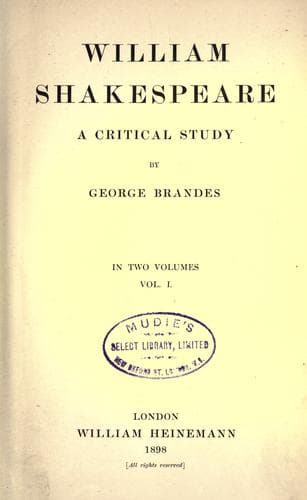
William Shakespeare: A Critical StudyBrandes, Georg
General
William Shakespeare: A Critical Study
Brandes, Georg
Shakespeare, William, 1564-1616 -- Criticism and interpretation
Ben Jonson has in this play woven together three different actions, one
only of which has a symbolic meaning outside the frame of the picture.
In the first place, he presents Ovid's struggle for leave to follow his
poetic vocation, his suspected love-affair with Augustus's daughter,
Julia, and his banishment from the court when Augustus discovers the
intrigue between the young poet and his child. In the second place, he
introduces us into the house of the rich bourgeois Albius, who has been
ill-advised enough to marry one of the emancipated great ladies of the
period, Chloe by name, and who, by her help, obtains admission to court
society. Chloe's house is a meeting-place for all the love-poets of the
period, Tibullus, Propertius, Ovid, Cornelius Gallus, and the ladies
who favour them; and Jonson has succeeded very fairly in suggesting
the free tone of conversation prevalent in those circles, which
was doubtless reproduced in many circles of London life during the
Renaissance. Finally, we have a representation--Jonson's chief object
in writing the play--of the conspiracy of the bad and envious poets
against Horace, which culminates in a formal impeachment. The Emperor
himself, and the famous poets of his court, form a sort of tribunal
before which the case is tried. Horace is acquitted on every count,
and the accusers are sentenced to a punishment entirely in the spirit
of the Aristophanic comedy--so foreign to Shakespeare--Crispinus being
forced to take a pill of hellebore, which makes him vomit up all the
affected or merely novel words he has used, which appear to Ben Jonson
ridiculous. Some of them--for example the first two, "retrograde" and
"reciprocal"--have nevertheless survived in modern English. In spite of
its allegorical character, the episode is not deficient in an almost
too pungent realism.
The most Roman of all these scenes are doubtless those in which the
gallantry between the young men and the ladies, and the snobbery which
forces its way into Augustus's court, are freely represented. Less
Roman, by reason of their too palpable tendency, are the scenes in
which Augustus appears in the circle of his court poets. No serious
attempt is made to portray the Emperor's character, and the speeches
placed in the mouths of the poets are very clearly designed simply for
the glorification of poetry in general, and Ben Jonson in particular.
The sins of which his enemies were always accusing him were "self-love,
arrogancy, impudence, and railing," together with "filching by
translation." As he explains in the defensive dialogue which he
appended to his play, it was his purpose--
"To show that Virgil, Horace, and the rest
Of those great master-spirits, did not want
Detractors then, or practisers against them."
Public-domain text, read in full here on John Shaqi.
Reviews
Reviews
No reviews yet
Be the first to share your thoughts on this work.
Elsewhere in the archive
Join the Discussion
Join the discussion
Sign in to leave a comment or review.
Sign InorCreate an account