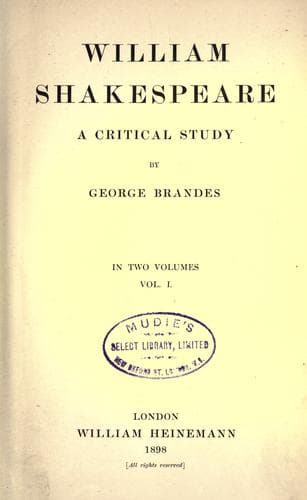
William Shakespeare: A Critical StudyBrandes, Georg
General
William Shakespeare: A Critical Study
Brandes, Georg
Shakespeare, William, 1564-1616 -- Criticism and interpretation
He makes foolish persons find injurious allusions to themselves, and
even insults to the Emperor, in entirely innocent poems of Horace's,
and shows how the Emperor orders them to be whipped as backbiters.
Horace's literary relation to the Greeks, be it noted, was not unlike
that of Ben Jonson himself to the Latin writers.
A special interest attaches for us to the passage in the fifth act,
where, immediately before Virgil's entrance, the different poets, at
the suggestion of the Emperor, express their judgment of his genius,
and where Horace, after warmly protesting against the common belief
that one poet is necessarily envious of another, joins in the general
eulogy of his great rival. There is this remarkable circumstance about
the encomiums on Virgil, here placed in the mouths of Gallus, Tibullus,
and Horace, that while some of them are appropriate enough to the real
Virgil (else all verisimilitude would have been sacrificed), others
seem unmistakably to point away from Virgil towards one or other famous
contemporary of Jonson's own. Look for a moment at these speeches (v.
I):--
"_Tibullus_. That which he hath writ
Is with such judgment labour'd, and distill'd
Through all the needful uses of our lives,
That could a man remember but his lines,
He should not touch at any serious point,
But he might breathe his spirit out of him.
_Augustus_. You mean, he might repeat part of his works
As fit for any conference he can use?
_Tibullus_. True, royal Cæsar.
_Horace_. His learning savours not the school-like gloss
That most consists in echoing words and terms,
And soonest wins a man an empty name;
Nor any long or far-fetch'd circumstance
Wrapp'd in the curious generalties of arts,
But a direct and analytic sum
Of all the worth and first effects of arts.
And for his poesy, 'tis so ramm'd with life,
That it shall gather strength of life, with being,
And live hereafter more admired than now."
Public-domain text, read in full here on John Shaqi.
Reviews
Reviews
No reviews yet
Be the first to share your thoughts on this work.
Elsewhere in the archive
Join the Discussion
Join the discussion
Sign in to leave a comment or review.
Sign InorCreate an account