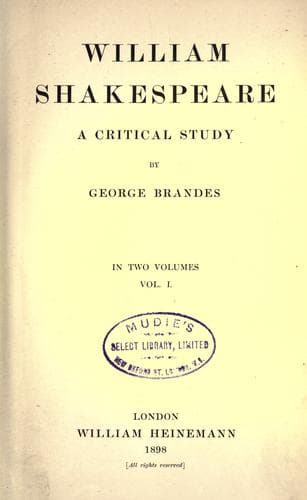
William Shakespeare: A Critical StudyBrandes, Georg
General
William Shakespeare: A Critical Study
Brandes, Georg
Shakespeare, William, 1564-1616 -- Criticism and interpretation
Can we conceive that Ben Jonson had not Shakespeare in his eye as he
wrote these speeches, which apply better to him than to any one else?
It is true that a Shakespeare scholar of such authority as the late C.
M. Ingleby, the compiler of _Shakespeare's Centurie of Prayse_, has
declared against this theory, together with Nicholson and Furnivall.
But none of them has brought forward any conclusive argument to
prevent us from following Ben Jonson's admirer, Gifford, and his
impartial critic, John Addington Symonds, in accepting these speeches
as allusions to Shakespeare. It is useless to be for ever citing the
passage in _The Return from Parnassus_, as to the "purge" Shakespeare
has given Ben Jonson, in proof that there was an open feud between
them, when, in fact, there is no evidence whatever of any hostility
on Shakespeare's part; and the very stress laid on the assertion that
Horace, as a poet, is innocent of envy towards a famous and popular
colleague, makes it unreasonable to take the eulogies as applying
solely to the real Virgil, whom they fit so imperfectly. Of course
it by no means follows that we are to conceive every word of these
eulogies as unreservedly applied to Shakespeare; the speeches seem to
have been purposely left somewhat vague, so that they might at once
point to the ancient poet and suggest the modern. But out of the mists
of the characterisation certain definite contours stand forth; and the
physiognomy which they form, the picture of the great teacher in all
earthly affairs, rich, not in book-learning, but in the wisdom of life,
whose poetry is so vital that it will live through the ages with an
ever-intenser life--this portrait we know and recognise as that of the
genius with the great, calm eyes under the lofty brow.
Ben Jonson's _Sejanus_, which dates from 1603, only two years after
_The Poetaster_, is a historical tragedy of the time of Tiberius, in
which the poet, without any reference to contemporary personalities,
sets forth to depict the life and customs of the imperial court. It is
as an archæologist and moralist, however, that he depicts them, and his
method is thus very different from Shakespeare's. He not only displays
a close acquaintance with the life of the period, but penetrates
through the outward forms to its spirit. He is animated, indeed, by a
purely moral indignation against the turbulent and corrupt protagonist
of his tragedy, but his wrath does not prevent him from giving a
careful delineation of the figure of Sejanus in relation to its
surroundings, by means of thoughtfully-designed and even imaginative
individual scenes. Jonson does not, like Shakespeare, display from
within the character of this unscrupulous and audacious man, but he
shows the circumstances which have produced it, and its modes of action.
Public-domain text, read in full here on John Shaqi.
Reviews
Reviews
No reviews yet
Be the first to share your thoughts on this work.
Elsewhere in the archive
Join the Discussion
Join the discussion
Sign in to leave a comment or review.
Sign InorCreate an account