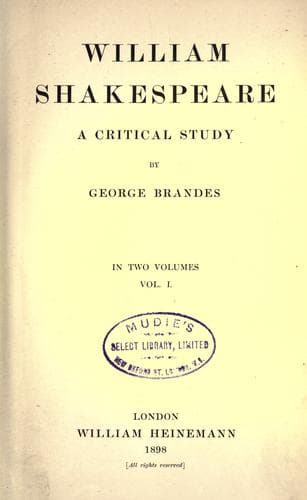
William Shakespeare: A Critical StudyBrandes, Georg
General
William Shakespeare: A Critical Study
Brandes, Georg
Shakespeare, William, 1564-1616 -- Criticism and interpretation
The possible jibe at _Twelfth Night_ in _Every Man out of his Humour_
(iii. I) has already been mentioned (_ante_, p. 272). That, too, must
be of late insertion, and is at worst extremely innocent.
Much has been made of the passage in _Volpone_ (iii. 2) where Lady
Politick Would-be, speaking of Guarini's _Pastor Fido_, says:--
"All our English writers
Will deign to steal out of this author, mainly:
Almost as much as from Montagnié."
This has been interpreted as an accusation of plagiarism, some pointing
it at the well-known passage in _The Tempest_, where Shakespeare has
annexed some lines, from Montaigne's Essays; others at _Hamlet_, which
has throughout many points of contact with the French philosopher. But
_The Tempest_ was undoubtedly written long after _Volpone_, and the
relation of _Hamlet_ to Montaigne is such as to render it scarcely
conceivable that an accusation of plagiarism could be founded upon it.
Here again Jonson seems to have been groundlessly suspected of malice.
Jacob Feis (_Shakespeare and Montaigne_, p. 183) would fain see in
Nano's song about the hermaphrodite Androgyno a shameless attack upon
Shakespeare, simply because the names Pythagoras and Euphorbus appear
in it (_Volpone_, i. I), as they do in the well-known passage in Meres;
but this accusation is entirely fantastic. Equally unreasonable is it
of Feis to discover an obscene besmirching of the figure of Ophelia in
that passage of Jonson, Marston, and Chapman's _Eastward Ho!_ (iii. 2)
where there occur some passing allusions to _Hamlet_.
There remain, then, in reality, only one or two passages in
_Bartholomew Fair_, dating from 1614. We have already seen (_ante_, p.
337) that there may possibly be a satirical allusion to the Sonnets
in the introduced puppet-play, _The Touchstone of True Love_. The
Induction contains an unquestionable jibe, both at _The Tempest_ and
_The Winter's Tale_, whose airy poetry the downright Ben was unable to
appreciate.[3] Neither Caliban nor the element of enchantment in _The
Tempest_ appealed to him, and in _The Winters Tale_, as in _Pericles_,
it offended his classic taste and his Aristotelian theories that the
action should extend over a score of years, so that we see infants in
one act reappear in the next as grown-up young women.
But these trifling intolerances and impertinences must not tempt us to
forget that it was Ben Jonson who wrote of Shakespeare those great and
passionate lines:--
"Triumph, my Britain! thou hast one to show
To whom all scenes of Europe homage owe.
He was not of an age, but for all time!"
[1] "Observe him as his watch observes his clock."--_Sejanus_, i. I.
[2] He says of Jonson in _The Times Displayed in Six Sesfyads_:--
Public-domain text, read in full here on John Shaqi.
Reviews
Reviews
No reviews yet
Be the first to share your thoughts on this work.
Elsewhere in the archive
Join the Discussion
Join the discussion
Sign in to leave a comment or review.
Sign InorCreate an account