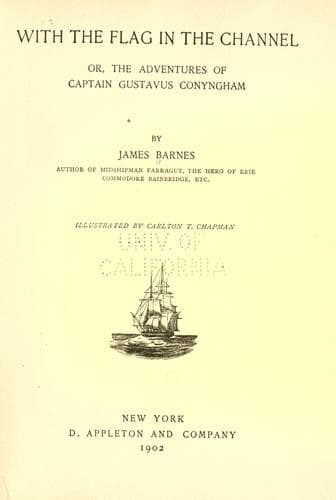
With the Flag in the Channel; or, The Adventures of Captain Gustavus ConynghamBarnes, James
History
With the Flag in the Channel; or, The Adventures of Captain Gustavus Conyngham
Barnes, James
United States -- History -- Revolution, 1775-1783 -- Juvenile fiction
At six o’clock that evening, in the little front room of the
Chanticlear Tavern, there were five men seated about the table. The
conversation, that had first been of home affairs and the discussion of
the latest news from the army--the battles of Trenton and Princeton and
Washington’s doings--soon turned to matters nearer at hand. Mr. Hodge,
a strong-featured, red-faced man of a traditional John Bull appearance,
sat between the two Ross brothers. After the waiter had left and they
were all alone he began to talk, and his audience resolved themselves
into the most eager listeners.
Conyngham had told his story of the capture of the prize crew, and
the recital had at once placed him as one who was worthy of every
confidence, and before whom everything could be said openly.
“You’d have laughed,” went on Mr. Hodge, continuing the story of his
trip to Paris, “to have heard the good doctor describe his arrival in
Paris. As yet he has not been received openly at court, but that will
all come in due time. Nevertheless, the number of fine names and titles
and high personages whom he has met would make quite a bill of lading.
You see Lord Stormont, the English ambassador, has his suspicions.
He would be a dolt if he hadn’t. And the Count de Vergennes, the
king’s Prime Minister, has his also, but the latter’s are the harder
to guess. I don’t exactly understand the Frenchman,” continued Mr.
Hodge. “He’s a bit too deep for me, and whether or not he is blowing
hot and cold to save time, or whether he is really anxious in the end
to be of service to us, is more than I can answer for. My own idea of
it is that he has but one idea in his head, and that is France, and
that he would see our country swamped and ruined if he could further
France’s interest in the slightest degree. He realizes, no doubt, that
in England’s troubles and difficulties lie France’s opportunities, and
that the more she is weakened and distressed, the easier it will be
for France when the war comes; for, mark my words, the temper of the
French people can not long be restrained, and sooner or later England
and this country will be at each other’s throats. But, nevertheless,
gentlemen, it is well worth our time to keep a wary eye on M. le Comte
de Vergennes, and mind his doings carefully. But I have digressed. I
was speaking of Franklin--he told me that Lord Stormont had objected to
his coming to Paris at all, and said that ‘if this arch-rebel reaches
the city I will away home with me, bag and baggage.’ ‘All right,’ says
de Vergennes, ‘anything to please your excellency! We will despatch
a messenger to stop him.’ And so a messenger was sent to meet the
diligence by which ‘Goodman Richard’ was coming into Paris, but the
messenger took the wrong road and never met the doctor, and the first
thing you know Lord Stormont hears that the ‘arch-traitor’ has arrived.
‘Heavens, mercy me!’ exclaims de Vergennes, when his lordship calls
upon him.
Public-domain text, read in full here on John Shaqi.
Reviews
Reviews
No reviews yet
Be the first to share your thoughts on this work.
Join the Discussion
Join the discussion
Sign in to leave a comment or review.
Sign InorCreate an account