With the Flag in the Channel; or, The Adventures of Captain Gustavus Conyngham — John Shaqi
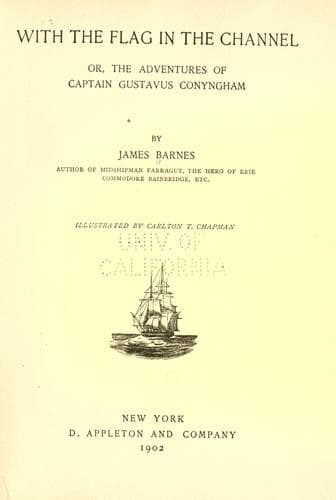
With the Flag in the Channel; or, The Adventures of Captain Gustavus ConynghamBarnes, James
History
With the Flag in the Channel; or, The Adventures of Captain Gustavus Conyngham
Barnes, James
United States -- History -- Revolution, 1775-1783 -- Juvenile fiction
‘How could it have happened? I will speak strongly to this
fool of a messenger. I will admonish him.’ ‘But what are you going to
do about it?’ insists Lord Stormont. ‘What can we do?’ returns Monsieur
le Comte. ‘You can not expect us to be uncivil! Surely it is no one but
an old gentleman who flies kites and writes almanacs, and we Frenchmen
have a reputation for politeness to sustain. We can not ask him to
leave without ceremony. It is not our way.’ So there he is,” continued
Mr. Hodge, “hob-nobbing with lords and ladies and what not, and
thinking great things in that great head of his; making arrangements
with Beaumarchais, who is our friend with good interest now. Oh, such a
man!” Mr. Hodge interrupted his long speech by throwing back his head
and laughing heartily.
“Beaumarchais? Beaumarchais? I’ve heard the name,” interrupted
Conyngham. “But who is he?”
“The most interesting and fantastic of creatures,” replied Mr. Hodge.
“A man whose career sounds like the invention of the romancer. His real
name is Caron, and he is but the son of a watchmaker, whose timepieces
are celebrated. I believe that he himself was brought up to follow his
father’s trade, but playing the harp attracted him more than adjusting
springs and balance-wheels, and he became an instructor and harpist at
the court. Being a man of parts besides of harps, and a natural born
courtier, he soon made his way and became one of the petted favorites
despite his lowly birth. A consummate Jack of all trades. He is the
author of plays, two of which I have had the pleasure of seeing--‘The
Barber of Seville’ and ‘The Marriage of Figaro.’ The king and the queen
trust him implicitly, and he has the ear of most of the noblemen,
though some of them dislike him and fear his sharp wits.”
“I met him once,” interrupted Mr. Allan, “at Nantes--a quietly dressed,
smooth-spoken, business-like fellow.”
“Then you don’t know him at court,” laughed Mr. Hodge, “for there he is
an exquisite, and can flutter his laces and make his bow with the best
of them. He has a hundred sides, and can change color like a chameleon.”
“He is a good friend of America and a hater of England,” remarked
the elder Ross. “If he had his way, Lord Stormont would be packed
off to London, bag and baggage, and there would be no more of this
dissembling. He knows the temper of the people, and has his finger on
the national pulse.”
“I wish that he had his fingers in the national purse,” laughed his
brother, “for the good doctor is not overburdened with money.”
The entrance of the landlord here interrupted the conversation, but
as soon as he disappeared Mr. Hodge, who had been doing a great deal
of thinking, and had paid little attention to the steaming ragoût,
followed him to the door and closed it firmly. Then, coming back to the
table, he leaned over his chair and in a low but eager voice addressed
the company.
Public-domain text, read in full here on John Shaqi.
Reviews
Reviews
No reviews yet
Be the first to share your thoughts on this work.
Join the Discussion
Join the discussion
Sign in to leave a comment or review.
Sign InorCreate an account