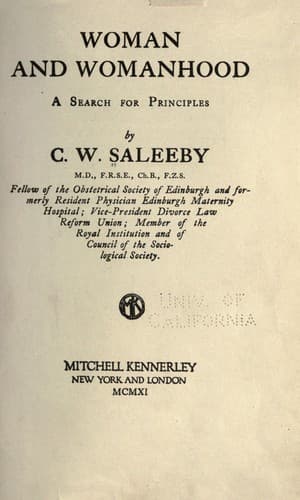
Woman and Womanhood: A Search for PrinciplesSaleeby, C. W. (Caleb Williams)
Science
Woman and Womanhood: A Search for Principles
Saleeby, C. W. (Caleb Williams)
Eugenics; Women
It is impossible to discuss, as we might well do, the available evidence
as to the effect of external activities upon that wonderful function of
womanhood which, in its correspondence with the rhythm of the tides,
hints, like many other of our attributes, at our distant origin in the
Sea--the mother of all living. Reference was made in an earlier chapter
to this function, and its use as, in most cases at any rate, a criterion
of womanhood and a gauge of the effect of physical exercise or mental
exercise thereupon. The writer of "Women and Economics" has nothing to
say on this subject--less, if possible, than on the subject of
lactation. The menstrual function would admirably and fundamentally
illustrate the present contention, but it will be better to take the
great maternal and mammalian function of nursing as a criterion of
womanhood, and as a test of the contention that the more freely the
mother works as do the savage woman and the peasant woman, the more
rightly she fulfils the "primal physical functions of maternity."
Before we consider the actual evidence (and Mrs. Gilman does not deal at
all in evidence on these fundamentals to her argument) let us meet the
argument about the "savage woman," who works as hard as men do,--though
much less hard than early observers of savage life supposed--and who is
nevertheless a successful mother. It is completely forgotten that, just
as parenthood, both fatherhood and motherhood, demands more of the
individual as we rise in the scale of animal evolution, so, within our
own species, the same holds good. In general, the mothers of civilized
races are the mothers of babies whose heads are larger at birth (as they
will be in adult life), than those of savage babies. It is true that the
civilized woman has, on the average, a considerably larger pelvis than
that of, for instance, the negress. There must be a feasible,
practicable ratio between the two sets of measurements if babies are to
enter the world at all. But the increasing size of the human head is a
great practical problem for women. No one can say how many millions have
perished in the past because their pelves were too narrow for the
increasing demands thus made upon them, and doubtless the greater
capacity of the female pelvis in higher races is mainly due to this
terrible but racially beneficent process of selection, by which women
with pelves nearer (e. g.) to negro type, have been rejected, and women
with wider pelves have survived, to transmit their breadth of pelvis to
their daughters and carry on the larger-headed races. But even now
obstetricians are well aware that the practical mechanical problem for
the civilized woman is much more serious than for her savage sister; and
the argument that civilized women would discharge maternal functions as
well as savage women if they worked as hard is therefore worthless.
Public-domain text, read in full here on John Shaqi.
Reviews
Reviews
No reviews yet
Be the first to share your thoughts on this work.
Elsewhere in the archive
Join the Discussion
Join the discussion
Sign in to leave a comment or review.
Sign InorCreate an account