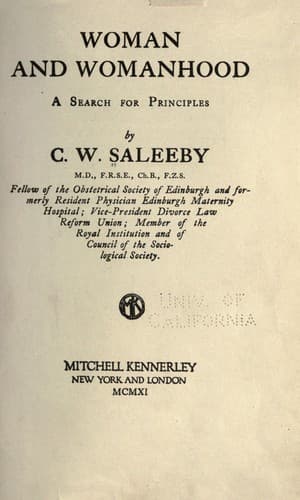
Woman and Womanhood: A Search for Principles — John Shaqi
Woman and Womanhood: A Search for PrinciplesSaleeby, C. W. (Caleb Williams)
Science
Woman and Womanhood: A Search for Principles
Saleeby, C. W. (Caleb Williams)
Eugenics; Women
or the light, has occurred. Its history is written indelibly in the
rocks. And, as we shall argue, this is the supreme lesson of
evolution--that progress is possible, because progress has occurred.
Assuredly we should never use this word "progress" without reminding
ourselves of the cardinal distinction that exists between two forms that
it may manifest. There is a progress which consists in and depends upon
an advance in the constitution of the living individual; and, so far as
we are more mental and less physical than the men who have left us such
relics as the Neanderthal skull, in so far we exemplify this kind of
progress. But, on the other hand, we can claim progress as compared with
even the Greeks in some respects, though there is no evidence whatever
that, so far as the individual is concerned, there is any natural,
inherent, organic progress. But we know more. Our school-boys know more
than Aristotle. We stand upon Greek shoulders. This is traditional
progress--something outside the germ-plasm; a thing dependent upon our
great human faculty of speech.
That, surely, is why the word infantine was rightly used in our first
paragraph. For we may ask why, if man be millions of years old, any
record of progress should be a matter of only a few thousand
years--perhaps not more than fifteen or twenty. The answer, I believe,
is that traditional progress depends upon the possibility of tradition.
Now speech, apart from writing, involves the possibility of tradition
from generation to generation, and I am very sure that "Man before
speech" is a myth; the more we learn of the anthropoid apes the surer we
may be of that. But, after all, the possibilities of progress dependent
upon aural memory are sadly limited; not only because it is easy to
forget, but because it is also conspicuously easy to distort, as a
familiar round-game testifies. The greatest of all the epochs in human
history was that which saw the genesis of written speech. I believe that
hundreds of thousands, nay millions, of preceding years were
substantially sterile just because the educational acquirements of
individuals could be transmitted to their children neither in the
germ-plasm (for we know such transmission to be impossible), nor outside
the germ-plasm, by means of writing. The invention of written language
accounts, then, we may suppose, for the otherwise incomprehensible
disparity between the blank record of long ages, and the great
achievement of recent history--an achievement none the less striking if
we remember that the historical epoch includes a thousand years of
darkness. Thus, as was said at the Royal Institution in 1907, when
discussing the nature of progress, we may argue in a new sense that the
historians have made history: it is the possibility of recording that
has given us something to record.
Public-domain text, read in full here on John Shaqi.
Reviews
Reviews
No reviews yet
Be the first to share your thoughts on this work.
Join the Discussion
Join the discussion
Sign in to leave a comment or review.
Sign InorCreate an account