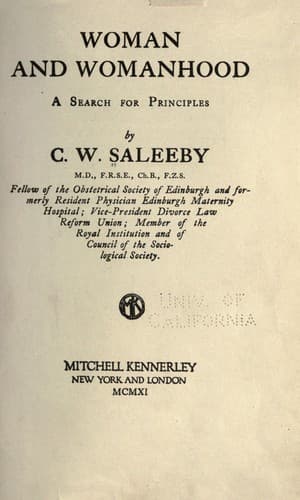
Woman and Womanhood: A Search for PrinciplesSaleeby, C. W. (Caleb Williams)
Science
Woman and Womanhood: A Search for Principles
Saleeby, C. W. (Caleb Williams)
Eugenics; Women
Now, it is in terms of this latter kind of progress that our duty to the
past, as we conceive it, may be defined. And in its terms also must we
define the grounds of our veneration for the past. None of us invented
language, spoken or written; nor yet numbers, nor the wheel, nor much
else. We see further than our ancestors because we stand upon their
shoulders, and, as Coleridge hinted, this may be so even though we be
dwarfs and they were giants. Some of us see this. How can we fail to do
so? And the past becomes in our eyes a very real thing, to which we are
so greatly indebted that we should even live for it. But there is a
great danger, dependent upon a great error, here. Let us consider what
is our right attitude towards the past. We are its children and its
heirs. We are infinitely indebted to it. We must love and venerate that
which was lovable and venerable in it. But are we to live for it?
If we could imagine ourselves coming from afar and contemplating the
sequence of universal phenomena now for the first time, we should
realize that the past, though real, because it was once real, is yet a
fleeting aspect of change, and, in a very real sense also, _is_ not.
Nor, indeed, _is_ the future; but it will be. We cannot alter, we cannot
benefit, we cannot serve the past, because it is not and will not be.
Our besetting tendency as individuals is to live for our own pasts, more
especially as we grow old; to become retrospective, to cease to look
forward, even to dedicate what remains to us of life to the service of
what is not at all. In this respect, as in so many others, we are less
wise than children. We will not let the dead bury its dead. This is also
the tendency of all institutions. Even if there were founded an
Institute of the Future, dedicated to the life of this world to come,
after only one generation its administrators would be consulting the
interests of the past, turning to the service of the name and the memory
of their founder, though it was for the future that he lived. Throughout
all our social institutions we can perceive this same worship of what no
longer is at the cost of the most real of all real things, which is the
life of the generation that is and the generations that are to be.
Everywhere the price for this idolatry is exacted. The perpetual image
of it is Lot's wife, who, looking backwards upon that from which she had
escaped, was turned into a pillar of salt. Nature may or may not have a
purpose, and exhibit designs for that purpose; she may or may not, in
philosophical language, be teleological. Man is and must be
teleological. We must live for the morrow, for what will be, whether as
individuals or as a nation, or our ways are the ways of death. This is
looked upon as a human failing--that man never is, but always to be
blest; that man is never satisfied, that he will not rest content with
present achievement.
Public-domain text, read in full here on John Shaqi.
Reviews
Reviews
No reviews yet
Be the first to share your thoughts on this work.
Join the Discussion
Join the discussion
Sign in to leave a comment or review.
Sign InorCreate an account