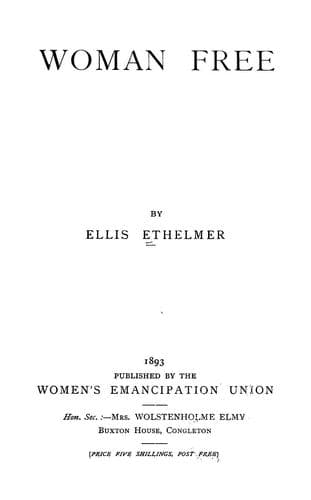
English poetry -- 19th century; Women -- History; Women -- Social conditions; Women -- Suffrage
⁂ A further newspaper correspondence concerning “The Nine Circles,” a
work from which some of the foregoing notes on vivisection are copied,
has gone on while “Woman Free” is passing through the press; the
vivisectors saying that certain of the incidents transcribed in “The
Nine Circles” are without the announcement that in some cases an
anæsthetic had been administered prior to the act of living anatomy,
otherwise admittedly true in every detail. The vivisectors lay what
stress they can on the omissions; indeed, their principal advocate has
made use of a grossness of imputation and a coarseness of invective that
augurs ill for any gentleness of treatment or purpose being existent in
the organism of such an operator.
Yet, in truth, it is not a matter of surpassing import whether the
assertion of the operation (alone) being conducted under an anæsthetic
be indubitable, since the after-consequences of pain or incommodity had
to be endured by the victim without anæsthetics. What initial
chloroforming could ward off the constant after-suffering attendant on
the incubation of the disease for the creation of which the “operation”
had been performed, a period acknowledgedly often lasting for weeks, and
terminated only by death’s mercy? Or what medicament could anæsthetise
the impotent yearning—to feed her starving puppy—of a poor mother dog
whose mammary glands had been excised, even if the “operation” had been
carried out “under chloroform”? Mr. Edward Berdoe, M.R.C.S., reproduces
and reprobates the incident with horror in the _Times_ of Oct. 27,
1892:—
“Professor Goltz amputated the breast of the mother of a puppy nursing
her young ... who ‘unceasingly licked the living puppy with the same
tenderness as an uninjured dog might do.’”
Most gladly may we turn to the words and ways of worthier seekers after
truth. Professor Lawson Tait is reported by the _Standard_, 28th Oct.,
1892, as saying at a meeting the previous day:—
“Vivisection was a survival from mediæval times. It could not be
justified by any results that it had produced. In days when they could
tell the composition of the atmosphere of Orion by means of the
spectroscope, it was a disgrace that men should resort to vivisection,
instead of perfecting other and more humane means of research.”
There speaks true science. And, on a later occasion, Mr. Lawson Tait
quotes the celebrated anatomist, Sir Charles Bell (who had been falsely
claimed as an advocate of vivisection), as saying, “on page 217 of the
second volume of his great work on the Nervous System, published in
1839”:—
Public-domain text, read in full here on John Shaqi.
Reviews
Reviews
No reviews yet
Be the first to share your thoughts on this work.
Elsewhere in the archive
Join the Discussion
Join the discussion
Sign in to leave a comment or review.
Sign InorCreate an account