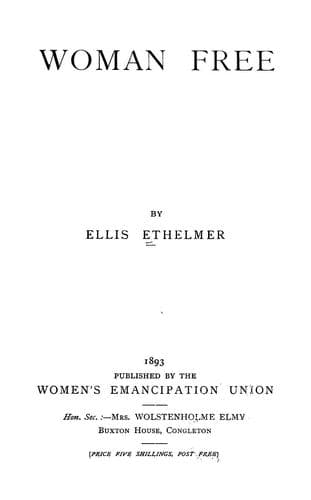
English poetry -- 19th century; Women -- History; Women -- Social conditions; Women -- Suffrage
“... a survey of what has been attempted of late years in physiology
will prove that the opening of living animals has done more to
perpetuate error than to confirm the just views taken from the study
of anatomy and natural motions.... For my own part I cannot believe
that Providence should intend that the secrets of nature are to be
discovered by means of cruelty, and I am sure that those who are
guilty of protracted cruelties do not possess minds capable of
appreciating the laws of nature.”—(The _Times_, Nov. 8th, 1892, p. 3.)
The views of Charles Bell and Lawson Tait are in striking and
encouraging coincidence with verses LIII., LIV., and LV.
To women peculiarly it belongs to oppose the doctrines and methods of
vivisectionists, for to the practitioners of that school were due the
arguments or assumptions which sufficed to introduce for a while into
our country the vile system of according a licence to male dissoluteness
and female subjection—under a pretext of public morality and
“scientific” sanction—known on the continent as the “police des mœurs,”
and in sundry Naval and Military stations of England and Ireland as the
“Contagious Diseases Acts.”
LV.
8.—“... _from Love’s might alone all thoughts of Wisdom grow_.”
“Hast thou considered how the beginning of all thought worthy the name
is love; and the wise head never yet was, without first the generous
heart?”—Carlyle (“French Revolution,” Vol. III., p. 375).
LVI.
5.—“_With woman honoured, rises man to height_.”
“If a Hindoo principality is strongly, vigilantly, and economically
governed; if order is preserved without oppression, if cultivation is
extended, and the people prosperous, in three cases out of four that
principality is under a woman’s rule. This fact, to me an entirely
unexpected one, I have collected from a long official knowledge of
Hindoo Governments.”—J. S. Mill (“The Subjection of Women,” p. 100
note).
6.—“_With her degraded, sinks again in night_.”
“And you who have departed from the common tradition, how have you fared
in the race of life? Are your men as brave and fearlessly truthful, are
your women as courageous and honest as in the old days of ‘the maiden’s
choice’? Are the little worn-out child-wives of to-day likely to have
descendants like those of the damsels of your ancient epics? Where are
the deeds of high emprise, of daring valour, and of patient persistence
of the youths who were fired by the pure love of a woman? Ah! gentlemen,
with love life departs; there is no vitality in married life without
affection, and when love, the great incentive to action, disappears from
the family, leaving dry the streams of affection which should flow
between the children and parents, what must come of the race?”—Mrs.
Pechey Phipson, M.D. (“Address to the Hindoos”).
Public-domain text, read in full here on John Shaqi.
Reviews
Reviews
No reviews yet
Be the first to share your thoughts on this work.
Elsewhere in the archive
Join the Discussion
Join the discussion
Sign in to leave a comment or review.
Sign InorCreate an account