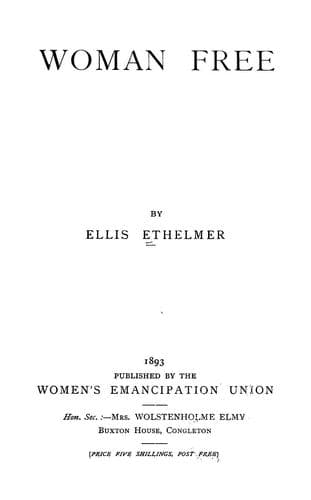
English poetry -- 19th century; Women -- History; Women -- Social conditions; Women -- Suffrage
_Id._... “From all we know of the laws of life and its development it
would appear one of the foolishest things on earth for men to fancy that
they can debase the intellect lobes of women, and at the same time exalt
their own. No breeder of cattle or horses would think of debasing the
qualities, in the females, which he would desire to possess in the
males.
“No race in the future can either rule the world or even continue in
existence without improving the intellect of that race, and this
certainly cannot be done by depauperising the intellects of more than
half of the _progenitors_ of that race.”—Dr. E. Bonavia (“Woman’s
Frontal Lobes”).
8.—“.... _Earth’s advancing queen_.”
“Will man den ganzen Menschen studiren, so darf man nur auf das
weibliche Geschlecht seine Augen richten: denn wo die Kraft schwacher
ist, da ist das Werkzeug um so künstlicher. Daher hat die Natur in das
weibliche Geschlecht eine natürliche Anlage zur Kunst gelegt. _Der Mann
ist geschaffen, ueber die Natur zu gebieten, das Weib aber, den Mann zu
regieren._ Zum Ersten gehört viel Kraft, zum Andern viel
Geschicklichkeit.”—Immanuel Kant.
LVII.
1.—“... _in jealousy_ ...”
The male conceit and jealousy of sex, existent among the majority of
meaner men, has been perceived and censured or satirised by higher
masculine minds both in ancient and modern literature. To take a few
scattered instances from the latter, Shakespeare says:—
“... however we do praise ourselves,
Our fancies are more giddy and infirm,
More longing, wavering, sooner lost and won
Than women’s are.”
—(“Twelfth Night,” Act II., Sc. 4.)
Goethe says pungently (in “Wilhelm Meister’s Apprenticeship”): “People
ridicule learned women and dislike even women who are well informed,
probably because it is considered impolite to put so many ignorant men
to shame.”
As our own plain-spoken Sydney Smith has said, in his essay on Female
Education:—“It is natural that men who are ignorant themselves, should
view, with some degree of jealousy and alarm, any proposal for improving
the education of women.”
A ludicrously pitiful modern-day instance of the jealous ignorance or
ignorant jealousy to which Goethe and Sydney Smith make reference, is
afforded by a seriously-written leading article in No. 545 of the
_Christian Commonwealth_, a London weekly newspaper, under date of 24th
March, 1892:—
Public-domain text, read in full here on John Shaqi.
Reviews
Reviews
No reviews yet
Be the first to share your thoughts on this work.
Elsewhere in the archive
Join the Discussion
Join the discussion
Sign in to leave a comment or review.
Sign InorCreate an account