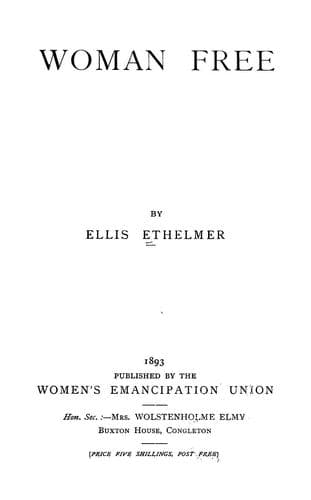
English poetry -- 19th century; Women -- History; Women -- Social conditions; Women -- Suffrage
“We are still the early settlers in a beautiful world, whose
capabilities, imperfectly known as yet, wait until higher developments
of man can understand them fully, and apply the result to the general
good.”—Professor T. Rupert Jones (Address as President of the Geological
Section of the British Association, 1891).
II.
3.—“... _keener conscience_ ...”
“C’est l’incarnation de l’idée qui se dresse tout à coup en face des
vieilles traditions obstinées et insuffisantes et elle vient ... poser
sa revendication personelle et nécessaire contre les lois jadis
excellentes, mais qui, les mœurs s’étant modifiées, apparaissent
subitement comme des injustices et des barbaries.”—A. Dumas fils (“Les
Femmes qui Tuent et les Femmes qui Votent,” p. 25).
IV.
7.—“... _monitor’s still voice_.”—_Conf._ Wordsworth;
“Taught both by what she” (Nature) “shows, and what conceals,
Never to blend our pleasure or our pride
With sorrow of the meanest thing that feels.”
(“Hart-Leap Well.”)
VI.
1.—“... _prehistoric hour_.”
“The preface of general history must be compiled from the materials
presented by barbarism. Happily, if we may say so, these materials are
abundant. So unequally has the species been developed, that almost every
conceivable phase of progress may be studied, as somewhere observed and
recorded. And thus the philosopher, fenced from mistake as to the order
of development, by the inter-connection of the stages and their shadings
into one another by gentle gradations, may draw a clear and decided
outline of the course of human progress in times long antecedent to
those to which even philology can make reference.”—M’Lennan (“Primitive
Marriage,” p. 9)....
_Id._... “I will confine myself to these examples, gleaned from all
parts, and which it would be easy to multiply. They amply suffice to
establish that, in primitive societies, woman, being held in very low
esteem, is absolutely reduced to the level of chattels and of domestic
animals; that she represents a booty like any other; that her master can
use and abuse her without fear. But in these bestial practices there is
nothing which approaches even distantly to marriage, and we are not in
the least warranted to call these brutal rapes marriages.”—Letourneau
(“Evolution of Marriage,” Chap. VI.).
2.—“... _woman thrall_ ...”
“Woman was the first human being that tasted bondage. Woman was a slave
before the slave existed.”—August Bebel (“Woman,” Chap. I.).
_Id._... “From the very earliest twilight of human society, every woman
(owing to the value attached to her by man, combined with her
inferiority in muscular strength) was found in a state of bondage to
some man.”—J. S. Mill (“The Subjection of Woman,” Chap. I.).
Public-domain text, read in full here on John Shaqi.
Reviews
Reviews
No reviews yet
Be the first to share your thoughts on this work.
Join the Discussion
Join the discussion
Sign in to leave a comment or review.
Sign InorCreate an account