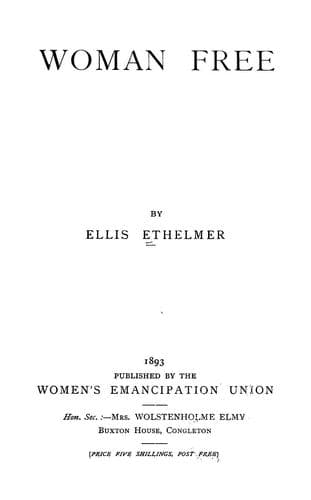
English poetry -- 19th century; Women -- History; Women -- Social conditions; Women -- Suffrage
_Id._... “In every country, and in every time, woman, organically weaker
than man, has been more or less enslaved by him.”—Letourneau (“The
Evolution of Marriage,” Chap. XI.).
_Id._...
“It raised up the humble and fallen, gave spirit and strength to the
poor,
And is freeing from slavery Woman, the slave of all ages gone by.”
—C. G. Leland (“The Return of the Gods”).
3.—“... _heinous skill_.”
“It is pitiful to reflect that man’s vaunted superiority over the brute,
the greater activity of his brain, and the subtler cunning of his hand,
have for so long lent themselves to the oppression that has resulted in
such pernicious consequences, and in the still existent slavery, social
and physical, of the female of his own species.”—Ben Elmy (“Studies in
Materialism,” Chap. III.).
8.—“... _soulless gloom_.”
Compare the following picture of the somewhat parallel condition of a
lower race at the present time:—
“Natives may well call the monkey sire Maharaja, for he is the very
type and incarnation of savage and sensual despotism. They are right,
too, in making their Hanuman red, for the old male’s face is of the
dusky red you see in some elderly, overfed human faces. Like human
Maharajas, they have their tragedies and mayhap their romances. One
morning there came a monkey chieftain, weak and limping, having
evidently been worsted in a severe fight with another of his own kind.
One hand hung powerless, his face and eyes bore terrible traces of
battle, and he hirpled slowly along with a pathetic air of suffering,
supporting himself on the shoulder of a female, a wife, the only
member of his clan who had remained faithful to him after his defeat.
We threw them bread and raisins, and the wounded warrior carefully
stowed the greater part away in his cheek pouch. The faithful wife,
seeing her opportunity, sprang on him, holding fast his one sound
hand, and, opening his mouth, she deftly scooped out the store of
raisins. Then she sat and ate them very calmly at a safe distance,
while he mowed and chattered in impotent rage. He knew that without
her help he could not reach home, and was fain to wait with what
patience he might till the raisins were finished. It was a sad sight,
but, like more sad sights, touched with the light of comedy. This was
probably her first chance of disobedience or of self-assertion in her
whole life, and I am afraid she thoroughly enjoyed it. Then she led
him away.”—J. Lockwood Kipling (“Beast and Man in India”).
VII.
1.—“... _Evolution_ ...”
Public-domain text, read in full here on John Shaqi.
Reviews
Reviews
No reviews yet
Be the first to share your thoughts on this work.
Join the Discussion
Join the discussion
Sign in to leave a comment or review.
Sign InorCreate an account