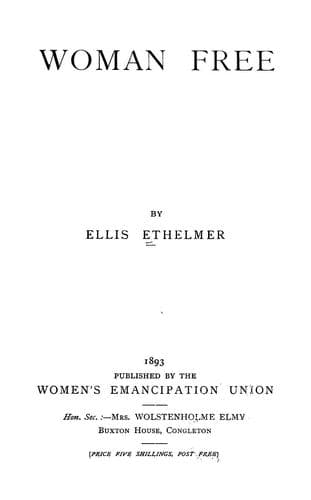
English poetry -- 19th century; Women -- History; Women -- Social conditions; Women -- Suffrage
_Id._... It will not be forgotten that, in more than one of the older
civilisations, the father had the power of life and death over the
members of the family, even past adult age.
And, to come to quite recent times, and this our England, Mrs.
Wolstenholme Elmy, to whose unflagging energy, during some fifteen years
of labour, was mainly attributable (as the Parliamentary sponsors of the
measures know) the amelioration in the English law concerning wives and
mothers, embodied in the Married Women’s Property Acts of 1870 and 1882,
together with the later and beneficent Guardianship of Infants Act,
1886, relates, in her record of the history of this latter Act:—
“It will be remembered that so recently as 1883, a young lady
petitioned that she might be allowed to spend her summer holidays with
her own mother, from whom she was separated for no fault of her own or
of her mother’s, but in virtue of the supreme legal rights of her
father. The Court refused her petition, natural and proper as it seems
to everyone of human feelings; and the words of the Master of the
Rolls in giving judgment, on the 24th of July, 1883, are more
significant and instructive as to the actual state of the law than the
words of any non-professional writer can be:—‘The law of England
_recognises the rights of the father_, not as the guardian, but
_because he is the father of his children_.... _The rights of the
father are recognised because he is the father_; his duties as a
father are recognised because they are natural duties. The natural
duties of a father are to treat his children with the utmost
affection, and with infinite tenderness.... The law recognises these
duties, from which if a father breaks he breaks from everything which
nature calls upon him to do; and, although the law may not be able to
insist upon their performance, it is because the law recognises them,
and knows that in almost every case the natural feelings of a father
will prevail. The law trusts that the father will perform his natural
duties, and does not, and, indeed, cannot, inquire how they have been
performed.... I am not prepared to say whether _when the child is a
ward of Court, and the conduct of the father is such as to exhaust all
patience—such, for instance, as cruelty, or pitiless spitefulness
carried to a great extent—the Court might not interfere. But such
interference will be exercised_ ONLY IN THE UTMOST NEED, AND IN MOST
EXTREME CASES. It is impossible to lay down the rule of the Court more
clearly than has been done by Vice-Chancellor Bacon in the recent case
of “_Re._ Plowley” (47 “L.T.,” N.S., 283). In saying that this Court,
“whatever be its authority or jurisdiction, _has no authority to
interfere with the sacred right of a father over his own children_,”
the learned Vice-Chancellor has summed up all that I intended to say.
_The rights of a father are sacred rights, because his duties are
sacred._...’
Public-domain text, read in full here on John Shaqi.
Reviews
Reviews
No reviews yet
Be the first to share your thoughts on this work.
Join the Discussion
Join the discussion
Sign in to leave a comment or review.
Sign InorCreate an account