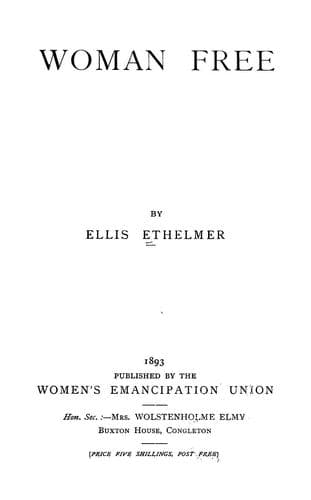
English poetry -- 19th century; Women -- History; Women -- Social conditions; Women -- Suffrage
_Id._... “What marriage may be in the case of two persons of cultivated
faculties, identical in opinions and purposes, between whom there exists
that best kind of equality, similarity of powers, and capacities with
reciprocal superiority in them—so that each can enjoy the pleasure of
looking up to the other, and can have alternately the pleasure of
leading and of being led in the path of development—I will not attempt
to describe. To those who can conceive it there is no need; to those who
cannot, it would appear the dream of an enthusiast. But I maintain, with
the profoundest conviction, that this, and this only, is the ideal of
marriage; and that all opinions, customs, and institutions which favour
any other notion of it, or turn the conceptions and aspirations
connected with it into any other direction, by whatever pretences they
may be coloured, are relics of primitive barbarism. The moral
regeneration of mankind will only really commence when the most
fundamental of the social relations is placed under the rule of equal
justice, and when human beings learn to cultivate their strongest
sympathy with an equal in rights and cultivation.”—J. S. Mill (“The
Subjection of Women,” p. 177).
XX.
2.—“_And lingers still the hovering shade of night_.”
George Eliot had yet to say, “Heaven was very cruel when it made women”;
and Georges Sand, “Fille on nous supprime, femme on nous opprime.”
XXI.
1.—“... _carnal servitude_...”
It may be objected by some that details in the verse or in these notes
are of too intimate a character for general narration. The notes have,
however, all been taken either from widely read public prints of
indisputable singleness of purpose, or works of writers of undoubted
integrity. One is not much troubled as to those who would criticise
further. To them may be offered the incident and words of the late Dr.
Magee, who, as Bishop of Peterborough, and a member of a legislative
committee on the question of child-life insurance, said:—“In this matter
we have to count with two things: first, almost all our facts are
secrets of the bedchamber; and, secondly, we are opposed by great vested
interests. This thing is not to be done without a good deal of
pain.”—(_Review of Reviews_, Vol. IV., p. 37).
And thus are verified, in a transcendental sense also, the words of
Schiller:—
“Und _in feurigem Bewegen_
Werden alle Kräfte kund.”
(“Die Glocke.”)
7.—“_Survival from dim age_ ...”
See Note XXIII., 1.
XXII.
1.—“... _girlhood’s helpless years_ ...”
Public-domain text, read in full here on John Shaqi.
Reviews
Reviews
No reviews yet
Be the first to share your thoughts on this work.
Join the Discussion
Join the discussion
Sign in to leave a comment or review.
Sign InorCreate an account