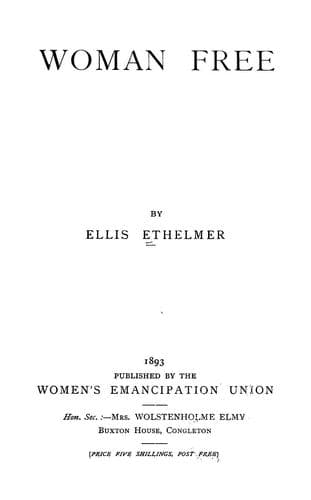
English poetry -- 19th century; Women -- History; Women -- Social conditions; Women -- Suffrage
XIX.
Happy the epoch destined to show
What force of good from that free fate shall flow;
The artificial limits to efface
Of laws and forms that womanhood debase;
Even our own imperfect hour may prove
The ecstasy of earnest souls that move
In dual union of unselfish strife
To reach by mutual love to true and equal life.
XX.
Yet slow, so slowly, gleams the gathering light,
And lingers still the hovering shade of night;
Though part undone the wrong that we confess,
Repentance cannot instant bring redress;
Nor woman, tortured by her thraldom long,
At once stand forth emancipate and strong;
Her pain persistent, though she calm suppress
Her rancour for the past, with sweet forgivingness.
XXI.
For carnal servitude left cruel stain,
And galls that fester from the fleshly chain;
Unhealed the scars of man’s distempered greed,
The wounds of blind injustice still they bleed;
Recurrent suffering lets her not forget
The aimless payments of a dismal debt,—
Survival from dim age of man’s abuse
Of functions immature, profaned by savage use.
XXII.
Her girlhood’s helpless years through cycles long
Had been a martyrdom of sexual wrong,
For little strength or choice might child oppose
To shield herself from force of sensual foes;
Impending motherhood might win no rest
Or refuge sacred from the satyr quest;
Unripe maternity, untimely birth,
The woman’s constant dole in those dark days of earth.
XXIII.
Action repeated tends to rhythmic course,
And thus the mischief, due at first to force,
Brought cumulative sequence to the race,
Till habit bred hereditary trace;
On woman falls that heritage of woe,
And e’en the virgin feels its dastard blow,—
For, long ere fit to wield maternal cares,
Abnormal fruits of birth her guiltless body bears.
XXIV.
Misread by man, this sign of his misdeed
Was held as symptom of her nubile need,
And on through history’s length her tender age
Has still been victim to his adult rage;
He, by his text, with irony serene,
Banned her resultant “manner” as “unclean”;
The censure base upon himself recoils,
Yet leaves the woman wan and cumbered in his toils.
XXV.
Vicarious punishment for manhood’s crime
Takes grievous toll of all her active prime;
The hap, in educated woman’s fate,
Is instinct with antipathy and hate;
Reason confirming tells, no honest claim
Could ever cause such gust of inward shame,
Nor act of normal wont might man blaspheme
To make of Nature’s need a vile opprobrious theme.
XXVI.
Public-domain text, read in full here on John Shaqi.
Reviews
Reviews
No reviews yet
Be the first to share your thoughts on this work.
Join the Discussion
Join the discussion
Sign in to leave a comment or review.
Sign InorCreate an account