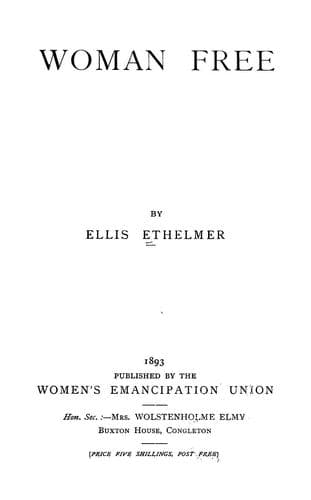
English poetry -- 19th century; Women -- History; Women -- Social conditions; Women -- Suffrage
Thoughts like to these are breathings of the truth
To whoso ponders deep the tale of ruth;
The futile mannish pleas that would explain
The purport of her periodic pain,
All bear unconscious witness to the wrong
In blindness born, in error fostered long,—
The spurious function growing with the years,
Till almost natural use the morbid mode appears.
XXVII.
Grievous the hurt to woman, which to right
Is instant duty of our stronger sight;
From off her weary shoulders, bruised and worn,
To lift the cross in longtime misery borne;
Until, reintegrate in frame and mind,
A speedy restitution she shall find,
From every trammel of man’s mastery freed,
Nor held by his behest from fullest life and deed.
XXVIII.
And soon may pass her suffering, for the ill
By man begot lies subject to our skill;
All human malady may be allayed
With human forethought, human action’s aid;
Ours then the fault, since, given in our hand
Is power the evil hazard to command;
For Nature, kindly wise our woes to shape,
In very pang of pain both prompts and points escape.
XXIX.
So woman shall her own redemption gain,
Instructed by the sting of bootless pain;
With Nature ever helpful to retrieve
The injury we heedlessly achieve,
From seed of act, by recent woman sown,
Already guerdon rich in hope is shown;—
Such faculty her new-found presence decks,
The sage physician, she, and saviour of her sex.
XXX.
With purer phase of life proves woman less
The burden of the wasting weariness;
And thus, in rank refined or rude have grown
Maidens in whom the weakness was not known;
Hale woman and true mother have they been,
Yet never have the noisome habit seen:
Not to neglectful man to greatly care
How such immunity all womanhood might share.
XXXI.
Her intellect alert the harm shall heal,
And ways of wholesomeness and strength reveal;
The saving truth she wins with studious thought
More swiftly to her daughter shall be taught,—
How body still is supple unto mind,
By dint of soul is fleshly form inclined,
And woman’s will shall work of man atone,
The deed his darkness wrought be by her light undone.
XXXII.
No longer drilled deformity to nurse,
And woo, when slow to appear, the absent curse,
Her counter-effort, helped by Nature’s grace,
Shall quell the “custom’s” last abhorrent trace;
Its morbid usurpation shall refute,—
Not more to woman natural than to brute;—
A needless noyance with a baseless claim,
The lingering mark of man’s unthinking guilt and shame.
XXXIII.
Public-domain text, read in full here on John Shaqi.
Reviews
Reviews
No reviews yet
Be the first to share your thoughts on this work.
Join the Discussion
Join the discussion
Sign in to leave a comment or review.
Sign InorCreate an account