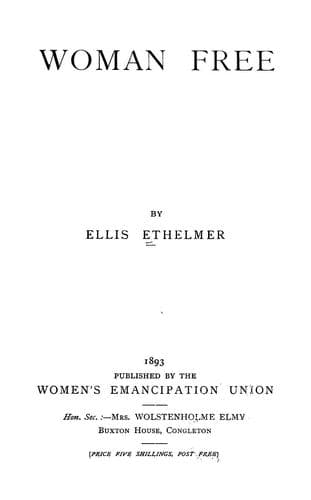
English poetry -- 19th century; Women -- History; Women -- Social conditions; Women -- Suffrage
_Id._... A. Dumas fils speaks of “les femmes, ces éternelles mineures
des religions et des codes;” and of “les arguments à l’aide desquels
l’Eglise veut mettre les femmes de son côté”; and shows as the effect
that “Il y a des femmes honnêtes, esclaves du devoir, pieuses. Leur
religion leur a enseigné le sacrifice. Non seulement elles ne se
plaignent pas des épreuves à traverser mais elles les appellent pour
mériter encore plus la récompense promise, et elles les bénissent quand
elles viennent. Tout arrive, pour elles, par la volonté de Dieu, et tout
est comme il doit être dans cette vallée des larmes, chemin de
l’éternité bienheureuse.... D’ailleurs elles ne lisent ni les journaux,
ni les livres où il est question de ces choses-là; cette lecture leur
est interdite. Si, par hasard, elles avaient connaissance de pareilles
idées, ... elles en rougiraient, elles en souffriraient pour leur sexe,
et elles prieraient pour celles qui se laissent aller à propager de si
dangereuses erreurs et à donner de si déplorables exemples.... Mais, pas
plus que le bonheur, la ruse, l’ignorance, la misère et la servitude, la
foi aveugle, l’extase, et l’immobilité volontaire de l’esprit ne sont
des arguments sans réplique.”—(“Les Femmes qui Tuent,” &c., pp. 10, 91,
103.)
The evil which Dumas points out is common to all religions, of whatever
race or make; the hall-mark of every creed, from Confucianism to
Comtism, has been the subjection of woman, under the affectation of
advocating her highest interests. The pious compound has usually been
altered to meet the growing intellectual requirements of common-sense
and justice and humanity, and hence the precepts of religion as to
feminine conduct have by no means always lain in such lines as the
multitude in our modern Western civilisation still enjoins on women. No
more than the whole and universal attitude of religion, ancient or
modern, as regards woman, is exposed or expressed in the following
recapitulation of present or historic facts:—“It is not the chastity of
women, as we understand it, but her subjection, that Japanese morality
requires. The woman is a thing possessed, and her immorality consists
simply in disposing freely of herself.
“As regards prostitution, Brahmanic India is scarcely more scrupulous
than Japan, and there again we find religious prostitution practised in
the temples, analogous to that which in ancient Greece was practised at
Cyprus, Corinth, Miletus, Tenedos, Lesbos, Abydos, &c. (Lecky, ‘History
of European Morals,’ Vol. I., p. 103). According to the legend, the
Buddha himself, Sakyamouni, when visiting the famous Indian town of
Vasali, was received there by the great mistress of the courtesans.
(Mrs. Spier, ‘Life in Ancient India,’ p. 28).”—Letourneau (“The
Evolution of Marriage,” Chap. X.).
Public-domain text, read in full here on John Shaqi.
Reviews
Reviews
No reviews yet
Be the first to share your thoughts on this work.
Elsewhere in the archive
Join the Discussion
Join the discussion
Sign in to leave a comment or review.
Sign InorCreate an account