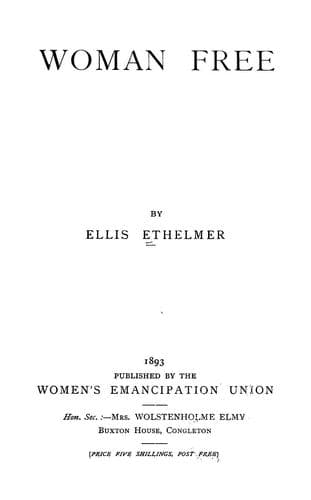
English poetry -- 19th century; Women -- History; Women -- Social conditions; Women -- Suffrage
“... the present position of women in regard to the various franchises
is anomalous and contradictory, unworthy of that great growth of
freedom which the nineteenth century has given to men, and degenerate
as regards the position which women held in the days of the
Plantagenets and the Tudors. Freedom for women has not broadened down
‘from precedent to precedent.’ Rather has it suffered by unnecessary
legislative interference. Every woman, except the Queen, is,
politically, non-existent. It was not always so. Restrictions unknown
to our ancient constitution have crept in.... Chief Justice Lee is
reported to have cited a case (in a manuscript collection of
Hakewell’s), Catherine _v._ Surrey, in which it was expressly decided,
that a _feme sole_, if she has a freehold, may vote for members of
Parliament; and a further one (from the same collection), Holt _v._
Lyle, in which it was decided, that a _feme sole_ householder may
claim a voice for Parliament men; but, if married, her husband must
vote for her; whilst Justice Page declared, ‘I see no disability in a
woman from voting for a Parliament man.’ So closely, in the minds of
our Judges, were the local and Parliamentary franchises bound up, that
a question as to the rights of women in local voting seemed to involve
considerations as to their right to vote for Parliament men.
“Yet, even in the matter of these local franchises, women have
suffered, and do suffer, from legislative tinkering and sex-biassed
decisions in our law courts.
“Down to 1835, women, possessing the qualifications which entitled men
to vote, voted freely in municipal elections, and in some important
cities, such as London and Edinburgh, the civic rights even of married
women, possessing a separate qualification from the husband, were well
established. The Municipal Corporations Act of 1835, however (passed
by the Whig administration of Lord Melbourne), was framed upon the
evil precedent of the Reform Act of 1832, and by the use of the words
‘male persons,’ in treating of the franchises under it, disfranchised
every woman in the boroughs to which it applied, and this
disfranchisement lasted for thirty-four years.
Public-domain text, read in full here on John Shaqi.
Reviews
Reviews
No reviews yet
Be the first to share your thoughts on this work.
Elsewhere in the archive
Join the Discussion
Join the discussion
Sign in to leave a comment or review.
Sign InorCreate an account