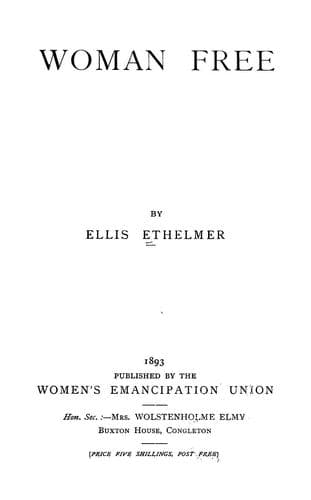
English poetry -- 19th century; Women -- History; Women -- Social conditions; Women -- Suffrage
“Les femmes Sphakiotes ne le cèdent en rien aux hommes pour la vigueur
et l’énergie. J’ai vu un jour une femme ayant un enfant dans les bras et
un sac de farine sur la tête, gravir, malgré ce double fardeau, la pente
escarpée qui conduit à Selia.”—Jules Ballot (“Histoire de l’Insurrection
Crétoise,” Paris, 1868, p. 251).
_Id._... In this context it is pleasant to find in the newspapers such a
note as the following:—
“The frost continued throughout West Cheshire yesterday, and skating
on rather rough ice was largely enjoyed. At Eaton, where the Duke of
Westminster is entertaining a party, the guests had a hockey match on
the frozen fish-pond in front of the hall. The players, who kept the
game up with spirit for over an hour, included the Duchess of
Westminster, the Marquis and Marchioness of Ormonde, Lady Beatrice and
Lady Constance Buller, Lord Arthur Grosvenor, Lord Gerald Grosvenor,
Lady Margaret and Lady Mary Grosvenor, Captain and Mrs. Cawley, Hon.
Mrs. Norman Grosvenor, Hon. Mrs. Thomas Grosvenor, General Julian
Hall, and party.”—(_Manchester Courier_, 12th Jan., 1892.)
Later on in the year we read in the journal _Woman_:—
“At the Marlow Regatta an extremely pretty girl in navy serge, built
Eton fashion, was a Miss ——, who wore as an under-bodice a full vest
of shaded yellow Indian silk. Her prowess with the oar is the cause of
daily admiration to the Marlowites.”
Again, on August 15th, 1892, the _Manchester Evening Mail_ has the
following:—
“An ailing ‘navvy,’ who has been engaged in some works near
Versailles, was a few days ago admitted to a hospital in that town.
Before the sick person had long been in the institution it was
discovered that the apparent ‘navvy’ was a woman. The superintendent
of the hospital was not in the least surprised on hearing of the
transformation scene, for it appears that he is accustomed to deal
with many woman patients who enter the hospital in male attire. It is
common in the district (says a Paris correspondent) for robust women
to don men’s garb in order to obtain remunerative employment as
navvies, porters, farm labourers, road menders, or assistants to
bricklayers, masons, and builders. It has long been established that
the average Frenchwoman of town or country has as great a capacity for
work either in counting-houses, shops, fields, or farms as her lord
and master has for laziness and lolling in the cafés, playing
dominoes, and smoking cigarettes.”
On the preceding day, August 14th, 1892, the St. Petersburg journals
reported that:—
Public-domain text, read in full here on John Shaqi.
Reviews
Reviews
No reviews yet
Be the first to share your thoughts on this work.
Elsewhere in the archive
Join the Discussion
Join the discussion
Sign in to leave a comment or review.
Sign InorCreate an account