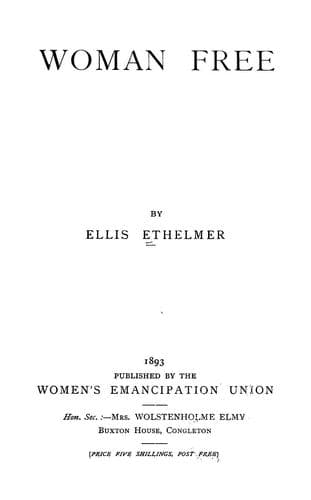
English poetry -- 19th century; Women -- History; Women -- Social conditions; Women -- Suffrage
“Ces jours-ci sera érigé à Sébastopol le monument élevé en l’honneur
des Femmes de cette ville qui, en 1854, ont construit seules une
batterie contre les troupes alliées. C’est une pyramide taillée en
granit d’une hauteur de cinquante pieds. Sur un côté est écrit en
lettres d’or: ‘C’est ici que se trouvait la batterie des Femmes’; sur
l’autre face les mots suivants sont gravés: ‘A cet endroit, en 1854,
les Femmes de Sébastopol ont construit une batterie.’ Le jour de
l’inauguration de ce monument n’est pas encore fixé. L’impératrice se
fera représenter à l’inauguration par un grand-duc.”
And, in October, 1892, the “sporting” newspapers recorded that:—
“Women are gradually coming to the fore as bicycle riders. Miss
Dudley, a well-known rider, has just accomplished a feat which would
have seemed wonderful for any rider not long ago. She has ridden from
a spot near Hitchin to Lincoln, a distance of 100 miles, in little
more than seven hours, or at the average speed of about fourteen miles
an hour. Mr. and Mrs. Smith are well-known as tandem riders, and they
have won many races together; but this is, perhaps, the first recorded
instance of a woman cyclist holding her own so well, unaided, in a
long road ride.”
See also “The Lancashire pit-brow women,” Note XVIII., 8.
7.—“_Of differing sex no thought inept intrudes_,”
“I have conversed, as man with man, with medical men on anatomical
subjects, and compared the proportions of the human body with
artists—yet such modesty did I meet with that I was never reminded by
word or look of my sex, and the absurd rules which make modesty a
pharisaical cloak of weakness.”—Mary Wollstonecraft (“The Rights of
Woman,” p. 278).
“As a careful observer remarks, true modesty lies in the entire absence
of thought upon the subject. Among medical students and artists the nude
causes no extraordinary emotion; indeed, Flaxman asserted that the
students in entering the Academy seemed to hang up their passions along
with their hats.”—Westermarck (“History of Human Marriage,” p. 194).
_Id._... “This is strikingly exemplified in the curious conversation
recorded in Lylie’s ‘Euphues’ and his ‘England,’ edit. 1605, 4to,
signature X—Z 2, where young unmarried people of both sexes meet
together and discuss without reserve the ticklish metaphysics of love.
But though treading on such slippery ground, it is remarkable that they
never, even by allusion, fall into grossness. Their delicate propriety
is not improbably the effect of their liberty.”—Buckle (“Common-place
Book,” No. 856).
8.—“_Their purpose calmly sure all errant aim excludes_.”
Public-domain text, read in full here on John Shaqi.
Reviews
Reviews
No reviews yet
Be the first to share your thoughts on this work.
Elsewhere in the archive
Join the Discussion
Join the discussion
Sign in to leave a comment or review.
Sign InorCreate an account