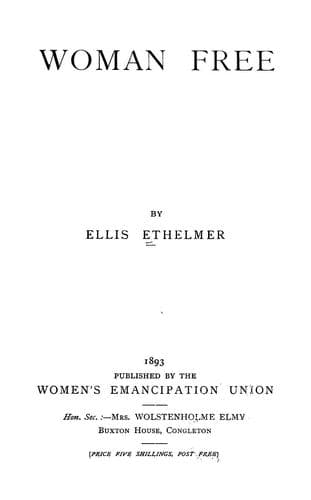
English poetry -- 19th century; Women -- History; Women -- Social conditions; Women -- Suffrage
“We point to a present remedy for undergraduate excesses, which, resting
on the soundest theory, has also the demonstration of unquestioned fact.
It is co-education. Cease to separate human beings because of sex. They
are conjoined in the family, in the primary and grammar schools, in
society, and, after the degree rewards four years of monastic student
existence, in the whole career of life.
“Throw open the doors of Harvard to women on equal terms, absorb the
annexe into the college proper, and as the night follows the day,
scholarship will rise, and dissipation fall by the law of gravitation.
The moral atmosphere will find immediate purification, and the daily
association of brothers and sisters in intellectual pursuits impart a
breadth of view which is an education in itself. The professors may then
be left safely to their themes, John Harvard’s statue may cease to dread
defilement, the regent will find his censorial duties fully as
perfunctory as he seems to have made them in the past, and character
will crowd out profligacy.”—William Lloyd Garrison (in _Woman’s
Journal_, Boston, U.S., 6th February, 1892).
“Whatsoever is ultimately decided by the wisdom of ages to be the best
possible form of culture for one human nature, must be so for another,
for one common humanity lies deeper in all and is more essential in each
than any difference.”—Sophia Jex-Blake, M.D.
XLVI.
3.—“... _impartial range_ ...”
Preparation in this direction is going steadily forward, not only in the
Western hemisphere, but in the Eastern. It is announced (in August,
1892) that
“Lady students at the five Universities in Switzerland number 224.
Berne is the most popular, with 78 female undergraduates; Zurich has
70; Geneva 70; the new University of Lausanne has five; and Basle one.
The medical faculty is in most favour with the female students, and
counts 157 of the whole number; the philosophical faculty follows with
62; five prefer the faculty of jurisprudence; the theological faculty
has not yet been invaded by the sex. More than half of the female
students, 116, are Russians, 21 Germans, 21 Swiss, 11 Americans, nine
Austrians, seven Bulgarians, four English, three Roumanians, and three
from the Turkish Empire, all of whom are young Armenian ladies.”
4.—“... _wider wisdom_ ...”
Such wider wisdom—without the preliminary suffering—as the poet had
attained to, when he wrote:—
“I have climbed to the snows of Age, and I gaze at a field in the Past,
Where I sank with the body at times in the sloughs of a low desire;
But I hear no yelps of the beast, and the man is quiet at last,
As he stands on the heights of his life with a glimpse of a height
that is higher.”
—Tennyson (“By an Evolutionist”).
_Id._—“... _juster ethics, teach_; ...”
Public-domain text, read in full here on John Shaqi.
Reviews
Reviews
No reviews yet
Be the first to share your thoughts on this work.
Elsewhere in the archive
Join the Discussion
Join the discussion
Sign in to leave a comment or review.
Sign InorCreate an account